Showing posts with label Traveling. Show all posts

Saturday, May 23, 2015

Urushi (漆)


One of the things that one sees a lot of here is lacquer-ware.  The beautiful deeply lustrous black and red (and clear) lacquer is a finish that is unparalleled and iconic.  So much so that you can also buy black and red plastic objects like rice bowls and spoons and trays that purport to emulate the finish, though there is really no comparison.  The only thing that is like urushi lacquer is urushi lacquer.

The binder for this lovely finish comes from the Japanese Sumac tree, which looks not unlike our own sumac trees back home.  This is a very different tree, however: the sap of the Japanese Sumac contains a compound called urushiol, which is the same toxin that is found in poison ivy.  The highly skilled craftspeople that work with urushi lacquer go through a period of extreme discomfort during which they are pretty much covered with the painful and highly itchy rash that any sufferer of poison ivy can relate to.  I have heard anecdotally that if someone who works with urushi takes a break from it for a week or two they have to build up a tolerance all over again when they come back to it again, that no  matter how long one has been working with urushi one still has to get re-acclimatized.

When I was young poison ivy was not of great concern.  I had a small case of it once or twice, but mostly I ran through the woods with abandon and very little repercussion.  In my early teens I started going to the local YMCA summer camp for a week or two each summer.  Camp Hanes taught me a lot of things: it taught me how to be responsible for younger people as a councillor in training (a lesson I put in to practice now in my work life) about rock climbing and backpacking, about how to sneak cigarettes and about power hierarchies and inequities.

One year I was art of a group called the Rangers.  It was not as militaristic as it sounds: it was sort of like a work/study program.  We went to morning workshops and then in the afternoon we did a few hours of work for the camp.  I quite enjoyed it, actually, as even then, when I was thirteen or fourteen or whatever I was I liked to be on the inside, to be part of the workings of a place rather than simply attending the place.  It was that same tendency that would lead me to start working backstage on shows, which would take me out of the great outdoors and into large dark rooms and the world of the entertainment industry.

I don't know if Camp Hanes still does the ranger program, I don't know if they would be allowed to.  We swung axes and used saws to prune trees, we clipped shrubs, we drove the golf carts around hauling trash, in general doing stuff in the eighties that would probably be looked at very differently in the litigious 21st century.

I can't for the life of me remember who the guy in charge of us was, but I remember what he looked like: skin swarthy form day after day in the North Carolina summer sun, leathery from years of being a Camel smoker.  He would smoke cigarettes while we worked, which always made us as campers (who were not allowed to smoke, officially) highly jealous and greatly desirous of a cigarette.  I remember him as tall (though in retrospect he may not have been) and I remember he had what we used to refer to as "Dunlop's disease:" his belly done lopped over his belt.  He had the thick, slow, round accent of the North Carolina hills, and a parsimony with words that will be familiar to people who have hung out around farmers and country folk at all.

One day our task was to clear the weeds from a small hill side next to the tennis courts.  This is probably almost 30 years ago and I remember it vividly.  Having been raised baby my mom to recognise plants by their leaves, I immediately spotted that the bulk of the weeds were poison ivy.  The boss man handed me a swing blade (a sort of horizontal blade set on a long handle) and told us to get to it.

"But that's poison ivy," I piped up, thinking maybe he had not noticed.  "Yep."  "And you want us to cut it with these?" "Yep." "Can I at least go up to my cabin and put on jeans?" "Nope.  Y'all can shower when yuh finnish." So we got to work.  To this day I remember the smell of those huge leaves as the swing blade cut their stems, the baking, sultry heat of the North Carolina summer sun, the sunburn starting to make my scrawny back pink.  I did shower, but to no avail, by the next morning the first welts started to form.  Then more.  Then more yet.  All the way up both legs and on both arms the poison ivy rash stood out.  I remember how painful it was, how terrifying as it kept spreading.  A couple of weeks later I went with my dad to his little home town in Michigan to visit my grandparents and I remember walking up the street with one of those curved chopping knives that I had found in the attic.  It reminded me of a battle axe so I was carrying it around.  The poison ivy was so itchy I remember stopping on the sidewalk and using the chopping knife to scrape at my legs, bent over and crying in frustration as the welts were torn away and the yellow pus inside them oozed down my legs.  Ever after I have been extremely sensitive to poison ivy and have mostly kept well away.

A few days ago, in Kyoto, we took the students to a sushi making experience.  We sat at long tables while the sushi chef (who was also the architect of the space and the owner) showed the students how to use the long sushi knife to cut slices of very fresh fish, and how to ball the rice and shape the sushi.  It was a fantastic experience and left us all stuffed full of sushi.

After we had eaten, Aki (the sushi chef) told us how the building we were in had been a factory where urushi lacquer was made and applied to rice bowls and spoons.  He talked about how he had bought the building and turned it into this beautiful ryokan, or Japanese style hotel, and showed us some lovely and quite old lacquer ware that he had collected, some of which had been made in that factory when it was still a factory.  We all listened and learned and generally had a good time.  He told us about the big slab tables that we were sitting at and about how he also loves to work wood, and how he had hand planed them and applied the urushi lacquer finish to them himself.  And he told us all how the space had only been open for three months but that he was very proud of it.

The next morning when I awoke my wrist was itching.  Not a normal "my wrist itches" sort of itch, but a deeper, more painful itch that I have come to know well.  Somewhere in that lovely space there must have been some urushi lacquer that was not fully cured.  And I found it.  And that is how I came to have poison ivy in Japan, and how I now know that the Japanese for "calamine lotion" is "cadamine."  And that is is really hard to find anti-itch stuff in a drug store when you can not read or speak the language.

The sushi was fantastic though.


Ouch.

Tuesday, May 19, 2015

Engawa (縁側)

As he showed me my room on our first night here, the tall, blonde, German (?) guy who works the desk at our hotel pointed out the lintel above an alcove in my room that leads to the bathroom.  "Be careful," he said, "in Japan it is painful to be tall."

A sketch of the engawa space leading into the bathroom
Now, I am not a tall guy, being as I am several inches south of six feet.  On the other hand, I am in a country in which I routinely find myself talking to or walking past adult humans who do not even come up to my shoulder.  So I crack my head on that lintel almost daily and every time I do I think to myself "In Japan it is painful to be tall."  We leave tomorrow and I wonder if I will even then be trained to duck as I step up into the little alcove.

The alcove is worth noting (and I have been since I got here not just because I keep rediscovering the top of the entry with my skull) because it represents a very Japanese space: engawa.  Transition is important in traditional Japanese architecture, and passage from one space to another, though fluid, is also often tightly composed.  An engawa space is one of the ways that this happens.  Typically it refers to a sort of veranda on a traditional Japanese house that is either open to the elements or enclosed with screens.  Here's a photo I took of a traditional house in a town called Takeyama last time I was here.  You can see the tatami room and then, beyond the screens, the engawa.  The user of the space does not walk out from the house into the garden, but has a period of adjustment, and interstitial space that eases the transition.  The other thing that this space does is that it allows for very deep eaves on a traditional house, which is good since shoji screens are mostly paper and those eaves protect the walls of the house and the paper screens form the elements.

Rough floor plan of my room.   
I don't have a veranda on my third floor room, of course, but this idea of "in between" space is so strong here that in a "Japanese style" room that is not very big to begin with I have not one but two of them.  I have been thinking about them as my own little engawa spaces.  They both have hardwood floor, and they flank the tatmi room, one inside the door and the other in the headbanging space between my room and the bathroom.  In fact, to come into the room, there is a little entry, maybe 3'-0" by 20", then a little step up to an engawa space which is where the closet for my futon is, and then you finally step onto the tatami.  The whole of the entry is maybe 36" x 60", so not huge, but there are several transitional spaces, utilising changes of level as well as changes of material and color.  The hardwood helps protect the tatmi, of course, but it also allows for an entry into a space, it compresses the user into a small space before opening them up into a larger, brighter space.  This has the effect, among other things, of making the space feel bigger than it is, because the user is experiencing it in contrast to the very small transition space.  The American architect Frank Lloyd Wright used this kind of transition quite often, and I think he learned it in his travels here. 

Being aware of this and experiencing it has been reminding me about the importance of transition, and of honoring the need to allow for transition.  So often in my life I do not build in time to process, time to enjoy, time to reflect.  So often I go from one thing directly into another.  Maybe there is value in emotional engawa. Temporal engawa.  Even in this small space "transition" is important enough that space has been set aside for it.  Maybe I would do well to take that lesson and apply it elsewhere in my life. At the very least I will tell myself this is why it was so important to put that lintel where it is.  Not just to make it painful to be tall.

Though in Japan, it is painful to be tall.


Wednesday, May 13, 2015

Konnichiwa (Coming/Coming Back)


It is 6.27 am on day three of my return visit to Japan, and I have been trying to think about how to write about this and what to write about it.  Coming back, it turns out, is different from coming here.  Sort of like a second date, you know you will be exhilarated and excited, but you also know how you will be exhilarated and excited.  Which does not lessen the experience at all but it does give it a different flavor.

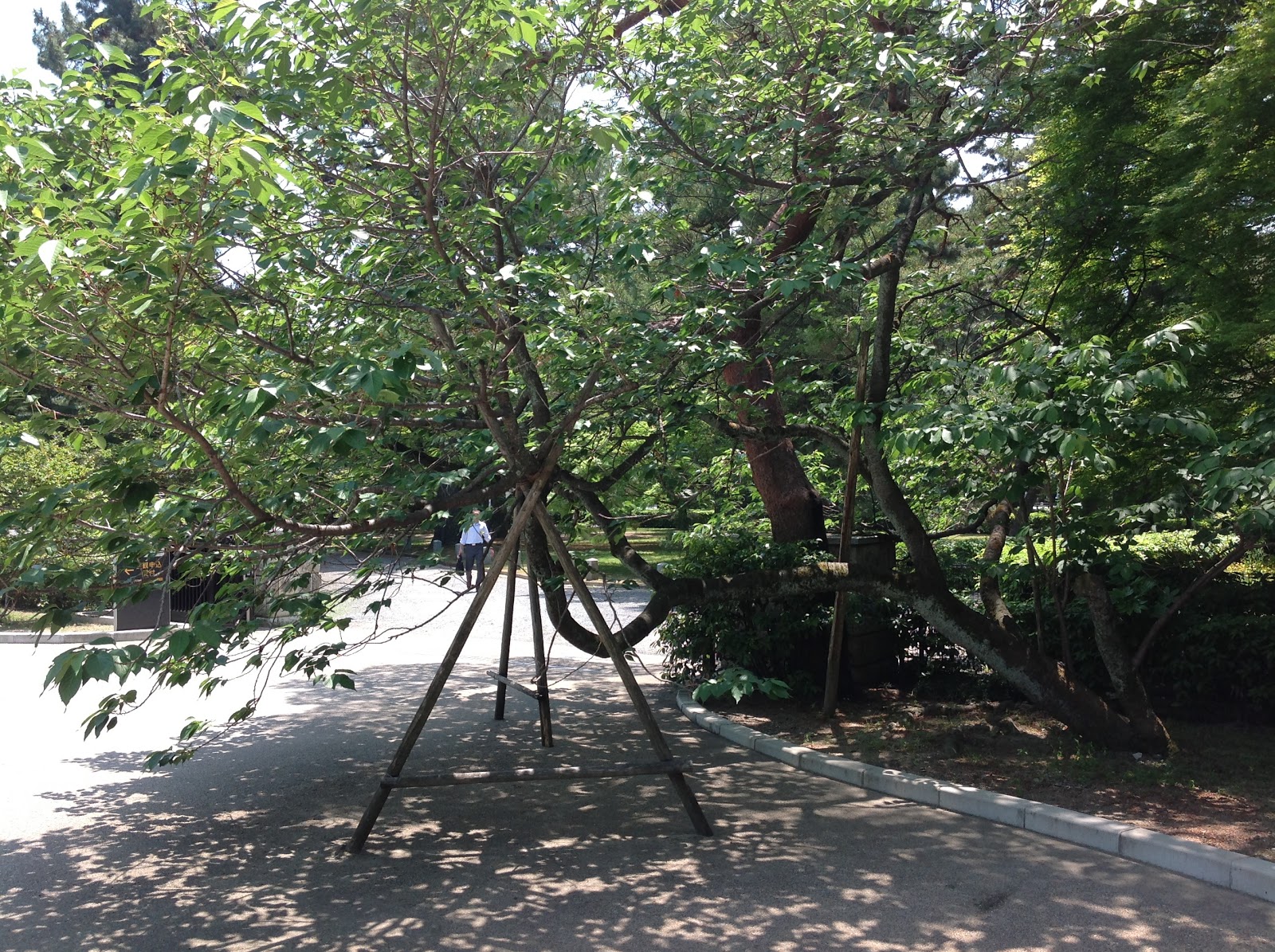
The difference in flavor is one that I have been trying to parse over the last couple of days as I settle into our routine here.  The first trip of course everything was a learning experience, everything was new, everything was exploration.  This time I knew exactly how to get to the good ramen shop, which streets lead to the knife store.  I know what to expect when I walk into the Imperial Palace to get our permits to visit Katsura Villa.  I am not just now finding out about propped-up trees, I am re-visiting old friends.

This has been true for a lot of things, and I have to admit to being a bit crestfallen as this process was revealed to me.  Like a lot of people I wanted the continued first flush of newness that I felt last time.  Of course that is childish, but the only other time I have been to Japan everything was so very new, so very alien, that the excitement of discovery actually started to wear me out by then end.

So I am taking stock and recalibrating.  We walked the students to Kiyomizu-dera, and I got to re-visit it, which, it turns out, was quite lovely.  Although familiar, it is no less stunning.  The massive beams and columns, the hand cut joints, the views of the city and the Western mountains beyond it, none of this is at all less enthralling.  But because I already have the photos of these views and these things, I felt released from the need to obsessively document, and was able to sit in the gloom of the temple and just smell the incense and feel the worn wood under me and listen to the big bell ring and the people swirling outside and just sink in to the experience itself.  How lovely.

I did do a little sketching, which I have decided I need to do more of in my time here, which reminded me how little I draw these days.  I hope to get better at it by the time we leave here.  And I did take a couple of photos.  But mostly what I did was sit and listen and smell and feel the place, and sit with my students, cajoling them to do the same.

Seems like that may be the flavor of this trip:  That instead of experiencing it through a little black plastic box I experience it the way that people have for centuries, and then relate it back through stories, which will have a different flavor this time.  Here are some sketches and photos:

Some sketches from today.

I love these baby Buddhas with bibs.

I took a photo of this last time, fun to draw it.

This is the big gong the sound of which reverberates throughout the temple.

Every temple has calligraphers, who will do calligraphy specific to the temple.  The three characters down the left hand side of this page are "kiyo,' "mizu," and "dera."
Just a dad waiting for his kiddos to come out of the temple.  Some things are familiar across cultures.

Just because you are in a stunning kimono doesn't mean you don't like a good selfie.

Some really nice CNC-cut planters for the side of a steep hill.
I love the way the curve of this maple tree accentuates the three dimensional grid of the columns and beams.

Saturday, June 8, 2013

A Tale of Two Dinners

I have not written much about the food I have been eating here, so as the trip winds up I wanted to record two very different but very Japanese gastronomic events.
The Raumen Museum.  Notice the bowls on the wall.

The first is here:  The Shin-Yokohama Raumen Museum.  Holy crap is this weird.  It is not a museum in the typical sense, rather, as the English-language guide says, it is "The first food amusement park to be created anywhere int he world."  I don't know if this is true, but it sounds good, so we'll take it.  For 300 yen (about $3.00) you enter into a gift shop (naturally).  Then you head down two flights of stairs and through a curtain and you say "holy hell, what is this?"  At least you say that if you are me.  Because although the pamphlet tells you that the museum "is divided into two themes are, a ramen restaurant mall and a 1:1 replica of a section of Tokyo in the year Showa33 (1958),"  You are really not ready for this.  It is, in fact, a replica of part of Tokyo in the year Showa 33.

Here I was, standing at night (it was lunchtime up above ground) on a little street of ersatz traditional structures.  The hi-fi system was playing "street sounds" like people talking and motorbikes going by a block away, and there were lights on in some windows next to and above us.  There was a door for a doctor's office, and a movie theater.  If you peered carefully into the windows, though, you could see the wall of the basement right behind the curtains.  It is all scenery.


"Why would you do this?" is a natural question, and here again the English language guide is helpful:  "Why did we reproduce the year Showa 33?  The mood from the good old days of Showa fills the visitor with nostalgia and an appetite to taste ramen.  And importantly, instant noodles were invented in 1958.  The invention transformed Japan into a nation of ramen connoisseurs."  Oh.  Well I suppose that makes sense, then.  Now that you mention it, I felt filled with nostalgia and an appetite to taste ramen. 

As we came around a corner, a deep courtyard opened up in front of us, filled with people eating ramen and drinking beer and (mildly inexplicably) watching a balloon artist make balloon shapes to a J-Pop soundtrack.  Because the other thing that the people behind the Raumen museum did is to gather nine of the best ramen shops in the world and get them to open an outpost here, under one roof.  So it is basically nine ramen restaurants in a basement in Yokohama surrounded by a pretend chunk of nostalgic Tokyo.  What's weird about that?


The balloon artist was pretty good, I have to say.
So we had ramen.  Weird, but damn good ramen.  Some of the best I have had on my trip.  Not a terribly educaitonal museum, maybe, but pretty wild nonetheless.

On to dinner last night:  My colleague and I went out to dinner because it will be our last while we are here.  Tonight we are supposed to be going to dinner with all of our students after their presentations, as a sort of "sayonara" thing, which will be nice, but we wanted to have one last dinner here as a way for us to say "goodbye" ourselves.  She said she had a good spot that a friend had taken her to last week and we set off.  We got off the train at Shimbashi, and walked a few blocks along a sort of alley beside the trains.  Tucked under the train tracks are a line of restaurants of various strip.  Some are just little ramen spots, one was called something like "Budweiser Adventure" and the gist seemed to be that you were assigned a "beer hostess" when you went in who catered to you during your stay and that posed for a photo when you left.  There are a bunch of joints like that here.  Creepy.  We went on until we found this cross street.  That is the train above, and restaurants below.

A tiny alley under the train that is NOT a bunch of scenery.
We walked past a little alley that looked for all the world like it was in the Raumen Museum, except that it wasn't and is real and is tiny and weird and filled with more sushi and noodle joints.  Then we got to this  joint.  No idea what the name is, but I think it roughly translates to "Some of the best damn sushi you will ever eat in your life so get the hell in here gaijin."  Or something like that.  Because it was.  We walked in past styrofoam crates of fish and fish parts, including one head and tail (see below) that I have to think were left out for effect.  But it did seem that everything had come from the fish market that day.  And it sure did taste like it.

We were the only non Japanese in the whole joint.  The space was really several smaller spaces that had been punched through into each other.  The floor was the street, there was an awkward curb running through the middle of one part of the restaurant.  Unlike slicker joints near the hotel, the wait staff was not terribly polished.  Lined up for a photo they would look like the cast of a Tom Waits song:  they were wearing jeans or sweatpants and Crocs.  One actually had a tattoo, one of the few I have seen here.  It was loud, smoky, and slightly impenetrable to a non-Japanese speaker.  It was perfect.

We selected "Today's Assorted Sushi" from the menu, but our waiter yelled at us and pointed elsewhere on the page and we shrugged and nodded and ordered two beers.  Sometimes it is better to let the experts handle things.  And they did.  A huge plate of some of the freshest sashimi I have ever had came out.  It was lovely.  one of the coolest things about it was that there was a little grater and some raw wasabi root on the wooden plate.  You ground your own wasabi.  It was so fresh and clean, I have never before had fresh wasabi.  What a difference.

After that we had tempura, which was also awesome.  What an amazing place, what an amazing time.  A great way to say goodbye to a place where I have learned so much and experienced so many new things.

The restaurant.
Some of "Today's Sushi Assortment," I suppose.


Alas, poor Yorrick.  He tasted good anyway.


Thursday, June 6, 2013

Warning: Extreme Tree Geekery!


 Ok, the time has come.  I have to write about the "propped up trees" phenomenon.  It might be my favorite thing about being here.

In every garden we visited, and in other places as well, we saw evidence that some trees are revered enough that arborists and gardeners will go to great lengths to save and protect them.  Which of course I love.  The trees in these gardens are not allowed to grow in a way that Americans might say is "natural."  They are pruned and trained into picturesque shapes that are as much living sculpture as anything else, often twisted shapes that look as though they have survived hundreds of years of buffering by the wind on some cliff face somewhere.

The thing is, this makes them really beautiful.  I always am struck by the ways that tree trunks can twist and hold that twist, or can grow horizontally and then vertically to reach the sun.  They really are sculptural objects in their own right, and they are everywhere already.  So lucky are we.

But in a Japanese garden or on temple or palace grounds, they are sculpted more deliberately, often to the limit of what the tree can endure.  This is where propping them up comes in.  Then there are the trees that obviously have some historic or religious significance (sometimes there is even a plaque describing it, but of course I can't read any of the plaques here).  These trees are propped up to keep them alive, and again, great lengths are gone to to keep them going. 

The props themselves are sometimes beautiful examples of woodworking.  They are often round poles (occasionally a foot in diameter, see below) with perfect mortice and tenon joints.  They are tied to the tree with a biodegradable twine, and often the tree is wrapped with bark or a grass mat to protect it.  It really is quite lovely to see, and the reverence that is accorded the trees is so lovely and so touching.  These are venerable beings, after all, much older, in many cases, than the gardeners who tend them.  They should be accorded the respect and gratitude we accord our elders, don't you think?  I love that there is such ubiquitous evidence that many people here feel as I do about trees.

Last thing before we move on to some photos:  I started this post with a piece of kanji that a student taught me.  It means (depending on how it is used) either "tree" or "wood"  Two of them next to each other means "small forest" and three of them means "forest."  I am digging the pictogram thing.  Intensely hard to parse, but my students have been teaching me a few characters and it is fun.  So three down, about 5,000 to go, and then I can start in on the pronunciation.  How hard can it be?

Ok, on to the photos of propped up trees:


 We'll start with a pretty run-of-the-mill propped up tree.  This is a lovely little pine on the grounds of the Imperial Palace in Kyoto.  There are two perfectly fitted mortices in the cross-piece.  Lovely piece of work.


 A slightly more elaborate propping up.  Also at the Imperial Palace in Kyoto.
 I wish I had some idea about this tree.  It is right at the corner of the castle building, and there was a huge plaque detailing its significance, but of course I could read none of it.  There was a date from the early 19th century, but that was the best I could figure out.  The trunk is about four feet in diameter, and the poles holding up the branches are each a foot thick.  You can get a sense of the scale from the police car there next to the tree.  This was one of the first things I saw in Japan and it won me over immediately.


 A close up of the whole process:  Wrap the branch in bark, then lash it with twine to the support pole.  This way as the tree grows it won't hurt the tree.  In a couple of places we even saw examples of the tree growing to support its own weight and growing off of the support.  Pretty triumphant to see that.
 
 A really nice example of the tree and the prop becoming a threshold into a space.  There is another photo of a similar thing later on, but this is a lovely one.  Many of these trees are bred to grow very slowly, so there is no guarantee that this tree is as callow as it seems, it could be quite old.  Again, this practice is so normative here that there is no comment on it, no way to know anything other than what we see.
 Maybe my second-favorite propped up tree.  So lovely.  This is in Katsura Villa, I think, so of course some of the top arborists in the nation are caring for this one.  I just love the horizontal and the tow verticals set up by this particular tree.
 The base of the supports for this tree land in a gravel garden, as this is in a Zen garden.  I love that the monks rake around the posts, acknowledging them as important objects and incorporating them into the raked pattern.
 A really tall propped up tree here.  Those supports are about thirty feet tall.  Still made the same way, with a perfect mortice at the top and lovingly lashed to the branches.  This  one is so tall that at first you are not aware of them as branch supports, but then you look up and realise that they are not a light post or something, that they are a part of the support system for the tree.


Sometimes support is in tension not compression.  Here is a little tree that is being trained to hang out over a path in a beautiful way.  Callow youth, this one.


I love it when the tree twists around like this.  Looks like the muscles in an arm, don't you think?  Here is an example of a tree that has been so tortuously trained that it could never stand on its own.  But it lives on.  The will to live is tenacious, even in (maybe especially in) trees, and they cling to life with great force of will.
 And here is my all-time, hands-down, favorite propped up tree.  At the entrance to Katsura villa.  Truly lovely, not least because all of the heartwood has been eaten by rot or mold or something, but the sapwood is still keeping the tree alive, twisted though it is.  The supports here are bigger than a foot in diameter.


 Here is another shot of this one.  You can see clear through it.  It is so beautiful, I just sat and stared at it for a long time.  The students were making fun of me after a while, but I did not care, it is just lovely.  I am so thankful that i have seen this old lady, when ever I start feeling like I have reached my limit I will remember her and remind myself to avail myself of support systems and lean on things that I need to lean on.  So much wisdom to learn from trees, and from those who take care of them.
 A nice example from inside Katsura Villa.  The ma created by the supports, the way they are there and not-there as the tree reaches out over the water is pretty amazing.

 From Tneryu-ji Zen temple in Arashiyama.  I love that the one branch has been trained so completely horizontally so that a real threshold has been made.  This is a very typical type, see below.

 From Bizen somewhere on the walk to the sword museum.  Using a tree as a lintel for entry into the house is a very common sight here, and one that I really dig.  What nicer way to delineate space than with trees?
And this poor lady gets the prize for most punk rock tree.  Holy crap.  There is such a thing as too much of a good thing, and this is one propped up tree that really shocked me.  I don't know if some terrible thing happened in its past, or if the gardeners are just over zealous, or what, but this is just crazy.  Nice one to end on, I think.