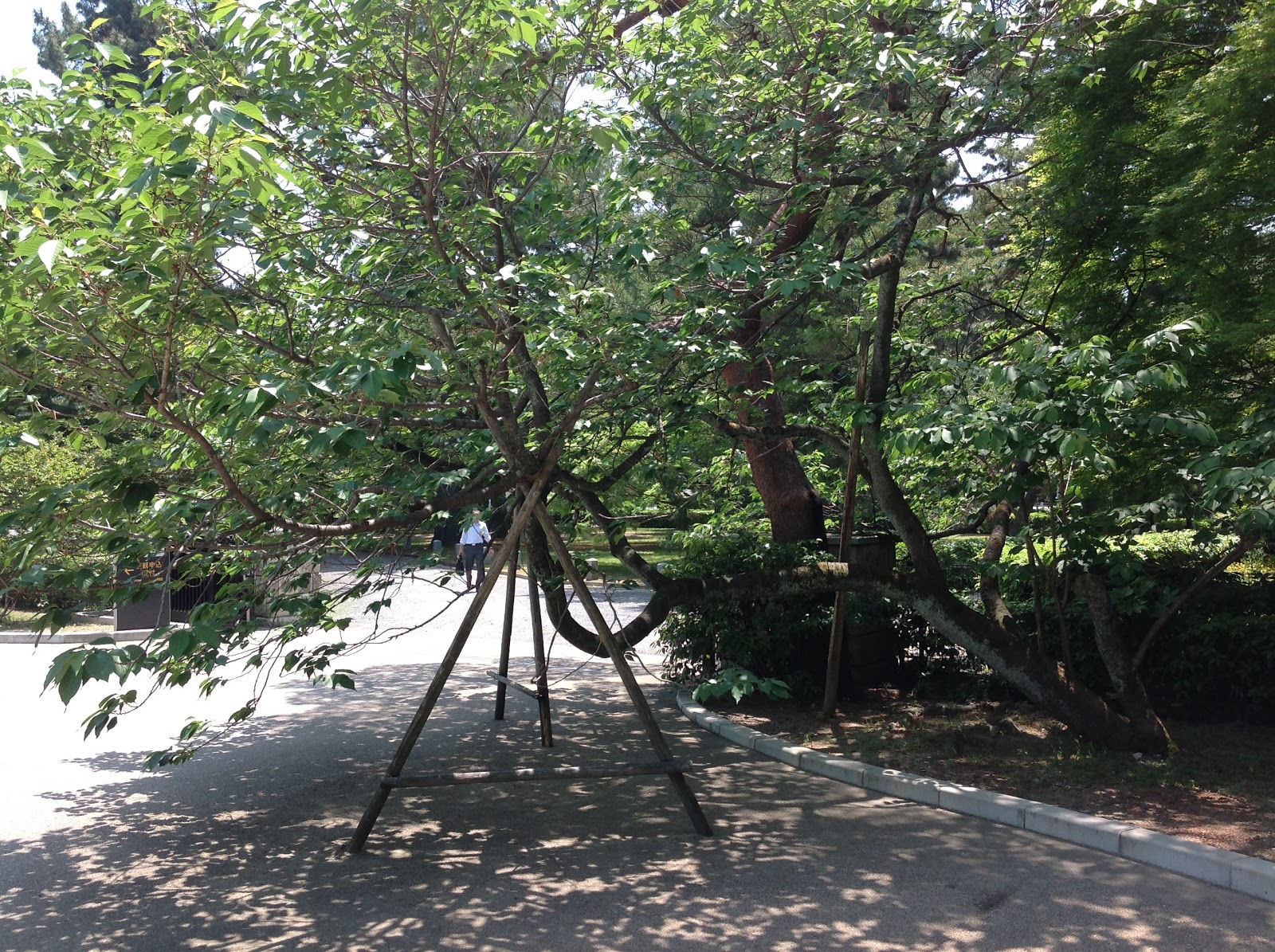
Ok, the time has come. I have to write about the "propped up trees" phenomenon. It might be my favorite thing about being here.
In every garden we visited, and in other places as well, we saw evidence that some trees are revered enough that arborists and gardeners will go to great lengths to save and protect them. Which of course I love. The trees in these gardens are not allowed to grow in a way that Americans might say is "natural." They are pruned and trained into picturesque shapes that are as much living sculpture as anything else, often twisted shapes that look as though they have survived hundreds of years of buffering by the wind on some cliff face somewhere.
The thing is, this makes them really beautiful. I always am struck by the ways that tree trunks can twist and hold that twist, or can grow horizontally and then vertically to reach the sun. They really are sculptural objects in their own right, and they are everywhere already. So lucky are we.
But in a Japanese garden or on temple or palace grounds, they are sculpted more deliberately, often to the limit of what the tree can endure. This is where propping them up comes in. Then there are the trees that obviously have some historic or religious significance (sometimes there is even a plaque describing it, but of course I can't read any of the plaques here). These trees are propped up to keep them alive, and again, great lengths are gone to to keep them going.
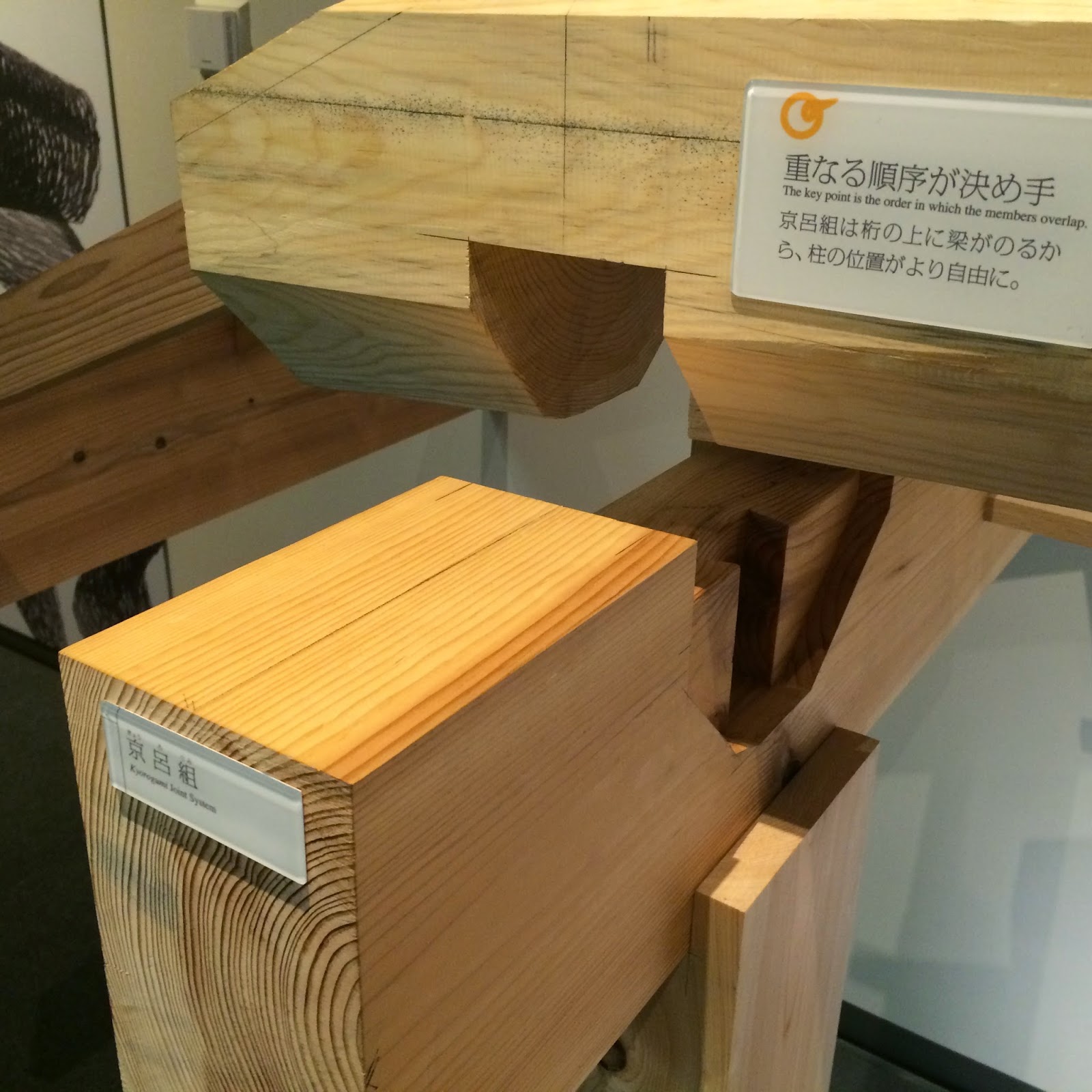
The props themselves are sometimes beautiful examples of woodworking. They are often round poles (occasionally a foot in diameter, see below) with perfect mortice and tenon joints. They are tied to the tree with a biodegradable twine, and often the tree is wrapped with bark or a grass mat to protect it. It really is quite lovely to see, and the reverence that is accorded the trees is so lovely and so touching. These are venerable beings, after all, much older, in many cases, than the gardeners who tend them. They should be accorded the respect and gratitude we accord our elders, don't you think? I love that there is such ubiquitous evidence that many people here feel as I do about trees.
Last thing before we move on to some photos: I started this post with a piece of kanji that a student taught me. It means (depending on how it is used) either "tree" or "wood" Two of them next to each other means "small forest" and three of them means "forest." I am digging the pictogram thing. Intensely hard to parse, but my students have been teaching me a few characters and it is fun. So three down, about 5,000 to go, and then I can start in on the pronunciation. How hard can it be?
Ok, on to the photos of propped up trees:
We'll start with a pretty run-of-the-mill propped up tree. This is a lovely little pine on the grounds of the Imperial Palace in Kyoto. There are two perfectly fitted mortices in the cross-piece. Lovely piece of work.
A slightly more elaborate propping up. Also at the Imperial Palace in Kyoto.
I wish I had some idea about this tree. It is right at the corner of the castle building, and there was a huge plaque detailing its significance, but of course I could read none of it. There was a date from the early 19th century, but that was the best I could figure out. The trunk is about four feet in diameter, and the poles holding up the branches are each a foot thick. You can get a sense of the scale from the police car there next to the tree. This was one of the first things I saw in Japan and it won me over immediately.
A close up of the whole process: Wrap the branch in bark, then lash it with twine to the support pole. This way as the tree grows it won't hurt the tree. In a couple of places we even saw examples of the tree growing to support its own weight and growing off of the support. Pretty triumphant to see that.
A really nice example of the tree and the prop becoming a threshold into a space. There is another photo of a similar thing later on, but this is a lovely one. Many of these trees are bred to grow very slowly, so there is no guarantee that this tree is as callow as it seems, it could be quite old. Again, this practice is so normative here that there is no comment on it, no way to know anything other than what we see.
Maybe my second-favorite propped up tree. So lovely. This is in Katsura Villa, I think, so of course some of the top arborists in the nation are caring for this one. I just love the horizontal and the tow verticals set up by this particular tree.
The base of the supports for this tree land in a gravel garden, as this is in a Zen garden. I love that the monks rake around the posts, acknowledging them as important objects and incorporating them into the raked pattern.
A really tall propped up tree here. Those supports are about thirty feet tall. Still made the same way, with a perfect mortice at the top and lovingly lashed to the branches. This one is so tall that at first you are not aware of them as branch supports, but then you look up and realise that they are not a light post or something, that they are a part of the support system for the tree.
Sometimes support is in tension not compression. Here is a little tree that is being trained to hang out over a path in a beautiful way. Callow youth, this one.
I love it when the tree twists around like this. Looks like the muscles in an arm, don't you think? Here is an example of a tree that has been so tortuously trained that it could never stand on its own. But it lives on. The will to live is tenacious, even in (maybe especially in) trees, and they cling to life with great force of will.
And here is my all-time, hands-down, favorite propped up tree. At the entrance to Katsura villa. Truly lovely, not least because all of the heartwood has been eaten by rot or mold or something, but the sapwood is still keeping the tree alive, twisted though it is. The supports here are bigger than a foot in diameter.
Here is another shot of this one. You can see clear through it. It is so beautiful, I just sat and stared at it for a long time. The students were making fun of me after a while, but I did not care, it is just lovely. I am so thankful that i have seen this old lady, when ever I start feeling like I have reached my limit I will remember her and remind myself to avail myself of support systems and lean on things that I need to lean on. So much wisdom to learn from trees, and from those who take care of them.
A nice example from inside Katsura Villa. The
ma created by the supports, the way they are there and not-there as the tree reaches out over the water is pretty amazing.

From Tneryu-ji Zen temple in Arashiyama. I love that the one branch has been trained so completely horizontally so that a real threshold has been made. This is a very typical type, see below.
From Bizen somewhere on the walk to the
sword museum. Using a tree as a lintel for entry into the house is a very common sight here, and one that I really dig. What nicer way to delineate space than with trees?
And this poor lady gets the prize for most punk rock tree. Holy crap. There is such a thing as too much of a good thing, and this is one propped up tree that really shocked me. I don't know if some terrible thing happened in its past, or if the gardeners are just over zealous, or what, but this is just crazy. Nice one to end on, I think.
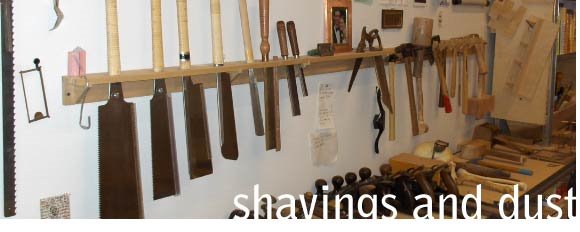


 So a historic hand plane has an existence as an object, a tool, a component in a carpenter's tool kit. But it also has relevance in a conversation about resources and resource usage, and about what a style of work or a style of workmanship communicates about a particular culture. And my hope is that by exposing our students to the style of making in another culture that it will underline for them the stylistic and functional choices and assumptions that they are making in their own work.