Today is Mark Twain's birthday. In honor of that I thought I'd post one of my favorite bits of writing from him, found in "Life on the Mississippi," which is a collection of memories and writings all about that great river. Captivating stuff, and a fun read.
This particular passage speaks well to the shift that comes as one moves from novice to skilled artisan. Beauty gets redefined, understanding deepens, worldview shifts. I do not think, as this passage indicates, that the ability to see beauty fades, rather that we understand things to be beautiful in different ways, if we let ourselves. Here, Twain is talking about the process of learning to "read the river" as a riverboat pilot.
"Now when I had mastered the language of this water and had come to know
every trifling feature that bordered the great river as familiarly as I
knew the letters of the alphabet, I had made a valuable acquisition. But I
had lost something, too. I had lost something which could never be
restored to me while I lived. All the grace, the beauty, the poetry had
gone out of the majestic river! I still keep in mind a certain wonderful
sunset which I witnessed when steamboating was new to me. A broad expanse
of the river was turned to blood; in the middle distance the red hue
brightened into gold, through which a solitary log came floating, black
and conspicuous; in one place a long, slanting mark lay sparkling upon the
water; in another the surface was broken by boiling, tumbling rings, that
were as many-tinted as an opal; where the ruddy flush was faintest, was a
smooth spot that was covered with graceful circles and radiating lines,
ever so delicately traced; the shore on our left was densely wooded, and
the somber shadow that fell from this forest was broken in one place by a
long, ruffled trail that shone like silver; and high above the forest wall
a clean-stemmed dead tree waved a single leafy bough that glowed like a
flame in the unobstructed splendor that was flowing from the sun. There
were graceful curves, reflected images, woody heights, soft distances; and
over the whole scene, far and near, the dissolving lights drifted
steadily, enriching it, every passing moment, with new marvels of
coloring.
I stood like one bewitched. I drank it in, in a speechless rapture. The
world was new to me, and I had never seen anything like this at home. But
as I have said, a day came when I began to cease from noting the glories
and the charms which the moon and the sun and the twilight wrought upon
the river’s face; another day came when I ceased altogether to note them.
Then, if that sunset scene had been repeated, I should have looked upon it
without rapture, and should have commented upon it, inwardly, after this
fashion: This sun means that we are going to have wind to-morrow; that
floating log means that the river is rising, small thanks to it; that
slanting mark on the water refers to a bluff reef which is going to kill
somebody’s steamboat one of these nights, if it keeps on stretching out
like that; those tumbling ‘boils’ show a dissolving bar and a changing
channel there; the lines and circles in the slick water over yonder are a
warning that that troublesome place is shoaling up dangerously; that
silver streak in the shadow of the forest is the ‘break’ from a new snag,
and he has located himself in the very best place he could have found to
fish for steamboats; that tall dead tree, with a single living branch, is
not going to last long, and then how is a body ever going to get through
this blind place at night without the friendly old landmark."
Happy Birthday, Mark Twain.
Showing posts with label beauty. Show all posts
Showing posts with label beauty. Show all posts
Wednesday, November 30, 2016


Sunday, June 28, 2015
Death: Before and After.
We only had a couple of days in Paris before we moved on again. Paris (like any major city) is impossible to "do," in the sense that you hear sometimes ("Well, we did London last year and this year we are going to do Paris). There are so many layers; so much history, so much present, so many cultures, so much much much that I think you could live there for years and never “do” it all. I lived in New York City for almost ten years and never made it to the Statue of Liberty, after all.
We happened to be staying a stone's throw from Notre Dame de Paris, and almost accidentally the trip became (mostly) about this structure. Of course it is art-historically significant and I studied it just a bit in college, and of course I was roughly familiar with it as a structure, but truly photos can never prepare one for actually inhabiting a building. What a breathtaking space.
It is a Gothic cathedral (perhaps the Gothic Cathedral) that is vast: Vastly wide, impressively long, and tall in a way that quite successfully makes a human feel tiny in the presence of god, which is what that space was meant to do after all. The builders employed a brand-new architectural conceit that we call a “cluster column,” that is, on the face of the piers that hold up the distant roof are carved delicate, tiny columns, one next to the other in a cluster, almost like a handful of asparagus, or maybe like holding a bunch of drinking straws of various sizes. The effect of this is to draw your eye up up up to the vaulted roof, you almost can’t help but follow the columns up to the heavens and there, peering up at the roof in awe you realize you are gazing heavenward and feeling small. Success in architecture.
This is a building that was begun in the 11th century and took a couple of hundred years to build. Thousands upon thousands of stones to be dressed and put in place, tons of iron to be smelted and cast and forged, beams to be hewn out of trees. It is a representation of millions upon millions of labor-hours of work across generations.
 I was particularly smitten by the
hinges. There are of course three main
doors into the western end of the Cathedral (this is normal for cathedrals,
especially of this style). Each entrance
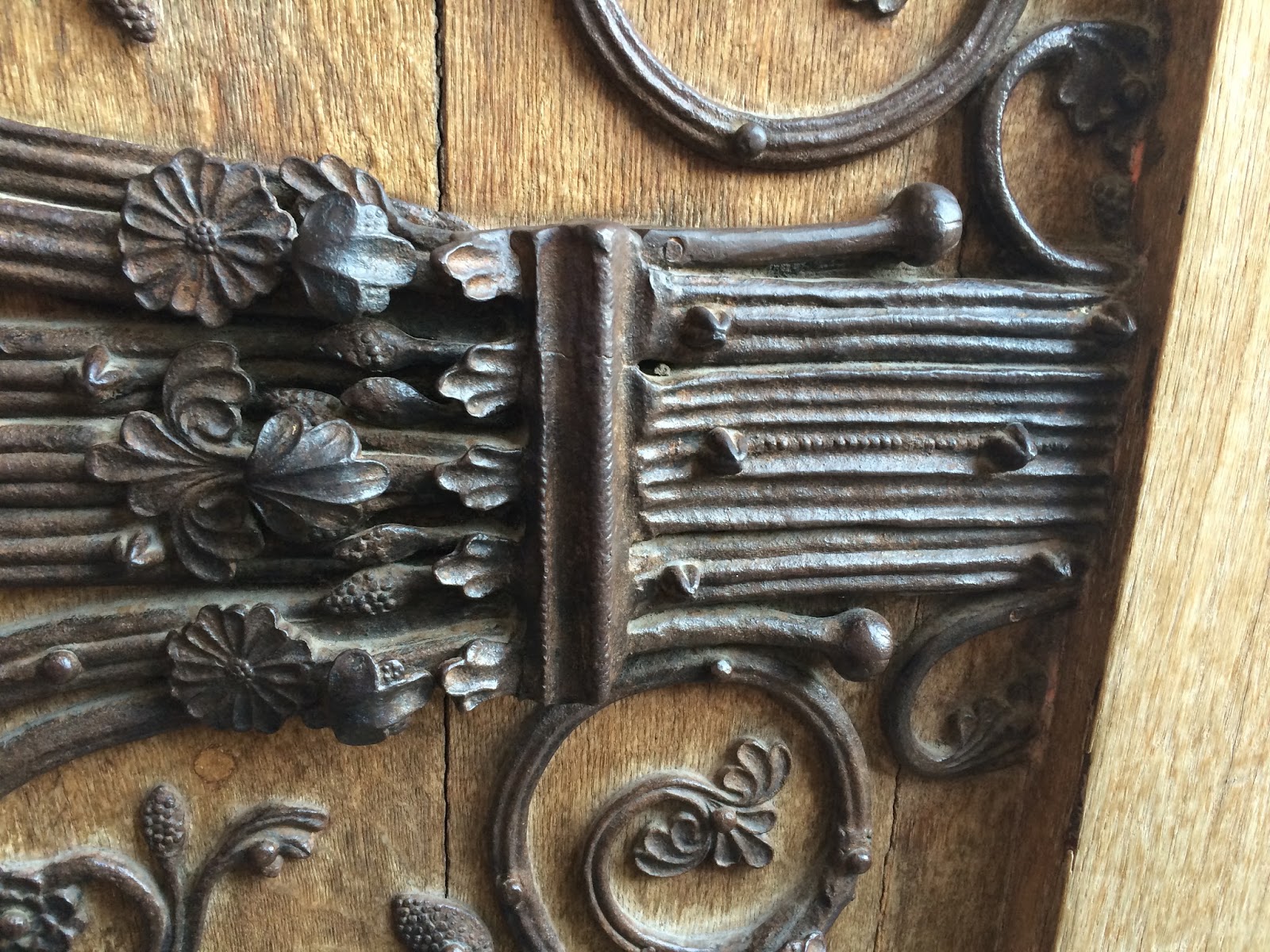
had a pair of doors and each door had three hinges. “NBD,” as my students say. But these hinges are something else. Large in scale, as everything is large in
scale in this structure, and strong, but visually delicate, almost spidery. They are massive pieces of forged iron, but
have an æsthetic identity that is almost light.
Knowing as I do a little bit about blacksmithing made me appreciate
these hinges even more: the idea of
forging them, even in parts, of getting that intricate detail without deforming
the steel, of achieving that level of symmetry again and again really is a
staggering thought. To look at these
hinges was to look at the work of a true master, a person who is so comfortable
with their hands and their tools and their material that they can make things
that no other, or few other, humans on the planet can make. This person or these people lived a thousand
years ago, and not only does no one now know their names, there is probably no
way to even find out what their names were.
All we have is their work which stands still, a thousand years later, as
testament to lives lived in service to making things with their hands that are
of use and that are beautiful and that are made in a way that with care they
will still do what they are intended to do a thousand years hence. What in my life does the same?
I was particularly smitten by the
hinges. There are of course three main
doors into the western end of the Cathedral (this is normal for cathedrals,
especially of this style). Each entrance
had a pair of doors and each door had three hinges. “NBD,” as my students say. But these hinges are something else. Large in scale, as everything is large in
scale in this structure, and strong, but visually delicate, almost spidery. They are massive pieces of forged iron, but
have an æsthetic identity that is almost light.
Knowing as I do a little bit about blacksmithing made me appreciate
these hinges even more: the idea of
forging them, even in parts, of getting that intricate detail without deforming
the steel, of achieving that level of symmetry again and again really is a
staggering thought. To look at these
hinges was to look at the work of a true master, a person who is so comfortable
with their hands and their tools and their material that they can make things
that no other, or few other, humans on the planet can make. This person or these people lived a thousand
years ago, and not only does no one now know their names, there is probably no
way to even find out what their names were.
All we have is their work which stands still, a thousand years later, as
testament to lives lived in service to making things with their hands that are
of use and that are beautiful and that are made in a way that with care they
will still do what they are intended to do a thousand years hence. What in my life does the same?Which brings me to the Paris Catacombs.
Different from the Roman catacombs in almost every way, the Paris catacombs are a series of tunnels that started as an underground quarry for that white stone that is ubiquitous here. In the late 18th century they started to collapse, and engineers were sent down to shore them up. At the same time, several cemeteries were being emptied, and all of the bones were brought down into the tunnels and stacked down there, since there was nothing else to do with the space. This resulted in a spectacularly creepy environment deep deep underground.
We have to a certain extent become inured to skulls and bones, I think. We see so many toys and Halloween decorations that are skulls and bones that I thought this would be more of the same: slightly creepy but mostly cool, and a fun afternoon. I was wrong on all counts.
As a starter, walking down a continuous stone spiral staircase some 9 or 10 stories underground is enough to creep me out. No elevator, so no quick escape if needed. No landings, either, just a relentless spiral down down down into the clammy darkness. The monotony of this part of the walk is meditative in its way, though the meditation is less than relaxing. At the base of this stair is a hallway, about 6 feet wide and maybe seven and a half feet tall in the center of the gently arched ceiling. Electric wall sconces light the way every thirty feet or so on alternating sides, meaning that the light is patchy, yellow, and barely lights the floor which is sloping, pitted, and, as my wife pointed out, “not something you would ever find in the States.”
The depth of this tunnel is almost palpable, you are keenly aware of the hundreds of feet of stone above you. Every so often there is a tunnel off to the right or left, dark as dark can be and locked off with an iron door like a prison door. I always find that not knowing evokes feeling considerably more than knowing, and the mystery of the dark tunnels with locked doors intensifies the already heightened feeling of extreme creepiness.
Then you get to the bones.
 It is almost like some Disney exhibit, there
are so many. Like the entrance to some
ersatz “pirate cave.” But these are
real. And there are thousands upon
thousands of them. Six or seven foot
retaining walls have been built out of femurs, with courses of skulls either
facing in or out. In some places the
skulls have been arranged in a shape, like a heart or a cross. In others they just continue in a long row,
face after fleshless face staring forever across the hallway at face upon
fleshless face staring back.
It is almost like some Disney exhibit, there
are so many. Like the entrance to some
ersatz “pirate cave.” But these are
real. And there are thousands upon
thousands of them. Six or seven foot
retaining walls have been built out of femurs, with courses of skulls either
facing in or out. In some places the
skulls have been arranged in a shape, like a heart or a cross. In others they just continue in a long row,
face after fleshless face staring forever across the hallway at face upon
fleshless face staring back. I had a real “poor Yorick” moment as I walked
through the cool damp semidark: All of
these bones had been a person, had been a child, had grown up, might have been
a parent or a sibling or a grandmom or a granddad. They probably loved and were loved, they
might have sung songs or played with their children, or enjoyed a sunset. They had birthdays and holidays, they
celebrated and cried. There was a human
life attached to each of these tens of thousands of femurs, each of the tens of
thousands of these skulls. No one will
ever have any way of finding out who these people were, where they lived, or
what their favorite food was. We won’t
know who their first kiss was or what they did as a job, or what was important
to them. These people have been dead for
hundreds of years. All we have are their
bones. Which of course is where the rest
of us are are all headed in time.
I had a real “poor Yorick” moment as I walked
through the cool damp semidark: All of
these bones had been a person, had been a child, had grown up, might have been
a parent or a sibling or a grandmom or a granddad. They probably loved and were loved, they
might have sung songs or played with their children, or enjoyed a sunset. They had birthdays and holidays, they
celebrated and cried. There was a human
life attached to each of these tens of thousands of femurs, each of the tens of
thousands of these skulls. No one will
ever have any way of finding out who these people were, where they lived, or
what their favorite food was. We won’t
know who their first kiss was or what they did as a job, or what was important
to them. These people have been dead for
hundreds of years. All we have are their
bones. Which of course is where the rest
of us are are all headed in time.
Which brought me back to Notre Dame de Paris, and to the
door hinges.
The people who made the door hinges are long lost in time
(“Lost in time like tears in rain,” as Roy Baty says in the Blade Runner
movie), but those hinges remain, and they keep doing the work they were
intended to do. Every morning the doors
swing open and every evening they swing shut, and the hands of the people that
put those doors on the hinges and the hinges on the building, though long
decayed to bones, are accessible to us.
We are so temporary, so fleeting, so small in space and
time. What the Catacombs and Notre Dame
made me think about is the import of making my short time here really mean
something, and of how much I want to make some things that live longer than I
do, even briefly.
Thursday, June 6, 2013
Warning: Extreme Tree Geekery!

Ok, the time has come. I have to write about the "propped up trees" phenomenon. It might be my favorite thing about being here.
In every garden we visited, and in other places as well, we saw evidence that some trees are revered enough that arborists and gardeners will go to great lengths to save and protect them. Which of course I love. The trees in these gardens are not allowed to grow in a way that Americans might say is "natural." They are pruned and trained into picturesque shapes that are as much living sculpture as anything else, often twisted shapes that look as though they have survived hundreds of years of buffering by the wind on some cliff face somewhere.
The thing is, this makes them really beautiful. I always am struck by the ways that tree trunks can twist and hold that twist, or can grow horizontally and then vertically to reach the sun. They really are sculptural objects in their own right, and they are everywhere already. So lucky are we.
But in a Japanese garden or on temple or palace grounds, they are sculpted more deliberately, often to the limit of what the tree can endure. This is where propping them up comes in. Then there are the trees that obviously have some historic or religious significance (sometimes there is even a plaque describing it, but of course I can't read any of the plaques here). These trees are propped up to keep them alive, and again, great lengths are gone to to keep them going.
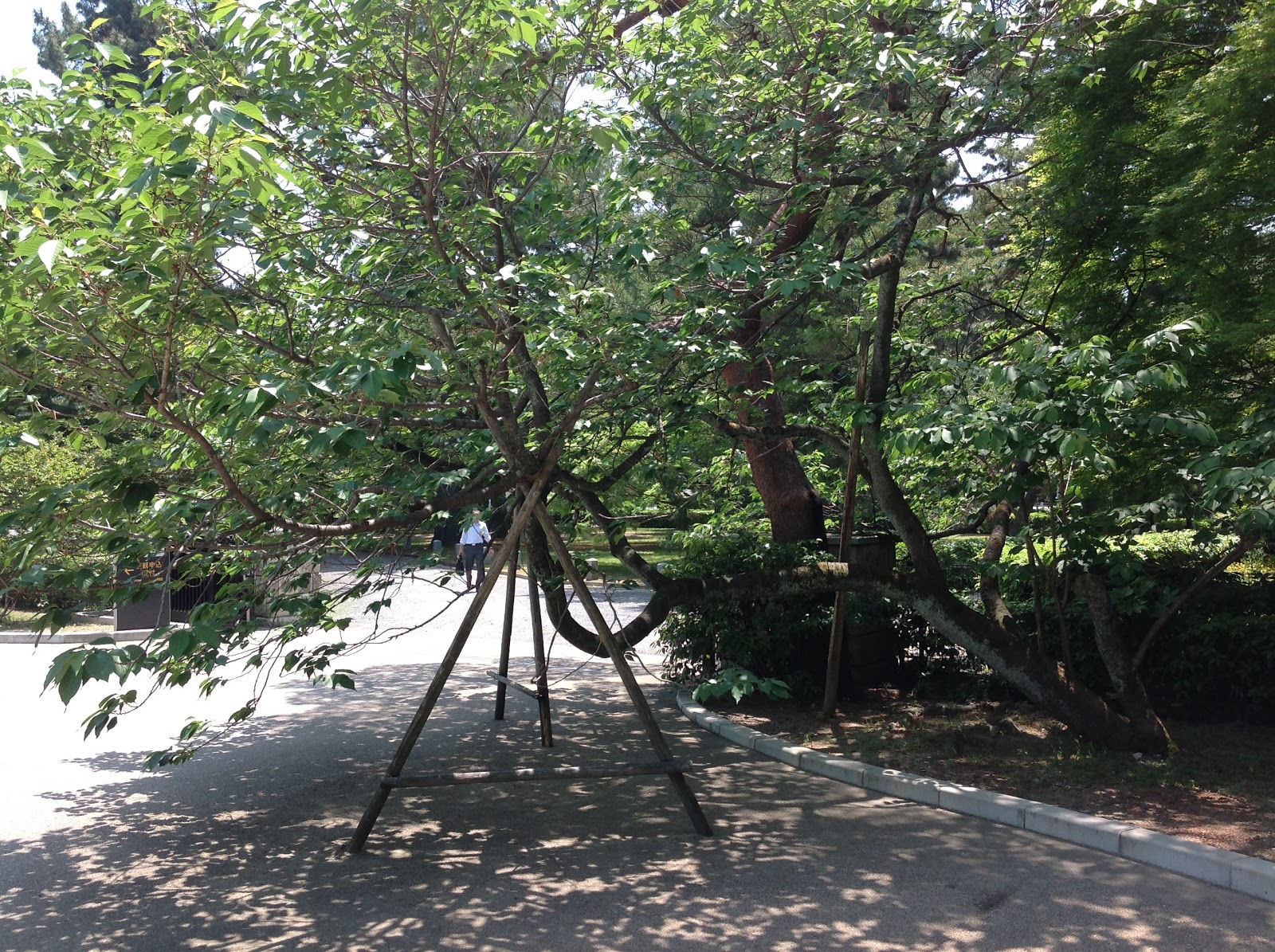
The props themselves are sometimes beautiful examples of woodworking. They are often round poles (occasionally a foot in diameter, see below) with perfect mortice and tenon joints. They are tied to the tree with a biodegradable twine, and often the tree is wrapped with bark or a grass mat to protect it. It really is quite lovely to see, and the reverence that is accorded the trees is so lovely and so touching. These are venerable beings, after all, much older, in many cases, than the gardeners who tend them. They should be accorded the respect and gratitude we accord our elders, don't you think? I love that there is such ubiquitous evidence that many people here feel as I do about trees.
Last thing before we move on to some photos: I started this post with a piece of kanji that a student taught me. It means (depending on how it is used) either "tree" or "wood" Two of them next to each other means "small forest" and three of them means "forest." I am digging the pictogram thing. Intensely hard to parse, but my students have been teaching me a few characters and it is fun. So three down, about 5,000 to go, and then I can start in on the pronunciation. How hard can it be?
Ok, on to the photos of propped up trees:



 |
Sometimes support is in tension not compression. Here is a little tree that is being trained to hang out over a path in a beautiful way. Callow youth, this one.

I love it when the tree twists around like this. Looks like the muscles in an arm, don't you think? Here is an example of a tree that has been so tortuously trained that it could never stand on its own. But it lives on. The will to live is tenacious, even in (maybe especially in) trees, and they cling to life with great force of will.


 From Tneryu-ji Zen temple in Arashiyama. I love that the one branch has been trained so completely horizontally so that a real threshold has been made. This is a very typical type, see below.

Subscribe to:
Posts (Atom)