Today is Mark Twain's birthday. In honor of that I thought I'd post one of my favorite bits of writing from him, found in "Life on the Mississippi," which is a collection of memories and writings all about that great river. Captivating stuff, and a fun read.
This particular passage speaks well to the shift that comes as one moves from novice to skilled artisan. Beauty gets redefined, understanding deepens, worldview shifts. I do not think, as this passage indicates, that the ability to see beauty fades, rather that we understand things to be beautiful in different ways, if we let ourselves. Here, Twain is talking about the process of learning to "read the river" as a riverboat pilot.
"Now when I had mastered the language of this water and had come to know
every trifling feature that bordered the great river as familiarly as I
knew the letters of the alphabet, I had made a valuable acquisition. But I
had lost something, too. I had lost something which could never be
restored to me while I lived. All the grace, the beauty, the poetry had
gone out of the majestic river! I still keep in mind a certain wonderful
sunset which I witnessed when steamboating was new to me. A broad expanse
of the river was turned to blood; in the middle distance the red hue
brightened into gold, through which a solitary log came floating, black
and conspicuous; in one place a long, slanting mark lay sparkling upon the
water; in another the surface was broken by boiling, tumbling rings, that
were as many-tinted as an opal; where the ruddy flush was faintest, was a
smooth spot that was covered with graceful circles and radiating lines,
ever so delicately traced; the shore on our left was densely wooded, and
the somber shadow that fell from this forest was broken in one place by a
long, ruffled trail that shone like silver; and high above the forest wall
a clean-stemmed dead tree waved a single leafy bough that glowed like a
flame in the unobstructed splendor that was flowing from the sun. There
were graceful curves, reflected images, woody heights, soft distances; and
over the whole scene, far and near, the dissolving lights drifted
steadily, enriching it, every passing moment, with new marvels of
coloring.
I stood like one bewitched. I drank it in, in a speechless rapture. The
world was new to me, and I had never seen anything like this at home. But
as I have said, a day came when I began to cease from noting the glories
and the charms which the moon and the sun and the twilight wrought upon
the river’s face; another day came when I ceased altogether to note them.
Then, if that sunset scene had been repeated, I should have looked upon it
without rapture, and should have commented upon it, inwardly, after this
fashion: This sun means that we are going to have wind to-morrow; that
floating log means that the river is rising, small thanks to it; that
slanting mark on the water refers to a bluff reef which is going to kill
somebody’s steamboat one of these nights, if it keeps on stretching out
like that; those tumbling ‘boils’ show a dissolving bar and a changing
channel there; the lines and circles in the slick water over yonder are a
warning that that troublesome place is shoaling up dangerously; that
silver streak in the shadow of the forest is the ‘break’ from a new snag,
and he has located himself in the very best place he could have found to
fish for steamboats; that tall dead tree, with a single living branch, is
not going to last long, and then how is a body ever going to get through
this blind place at night without the friendly old landmark."
Happy Birthday, Mark Twain.
Showing posts with label intentions. Show all posts
Showing posts with label intentions. Show all posts
Wednesday, November 30, 2016


Tuesday, December 29, 2015
Teaching Philosophy
I am engaged in something right now that is making me re-read my teaching philosophy. I wrote it last year, but it still feels right. It goes like this:
Teaching Philosophy
I
believe that design and making are active
not passive. We must be present, committed, thoughtful and directly involved in
the world in order to become agents of positive change. To this end, I believe that a solid design
education has three parts: inquiry, making, and aspirational thinking.
Inquiry
When I Socratically
ask a student why they made a particular choice, they must unpack their own
motives and assumptions. This helps them
to be more critical, more aware and more thoughtful as they engage in the
design process. So often we can be unaware of the questions we are really
asking, and this is especially true in young designers. Students in our senior thesis class (a
two-semester required course), determine for themselves the subject of their
individual projects. The only
stipulations are that the thesis must be applicable in Syracuse NY and respond
to a demonstrable need in this locale.
This encourages them to directly engage local communities, to research
existing social and cultural conditions and to think critically about their
response to those conditions. Students
guide their own studio work through discussion with each other and with the
other stakeholders in the project.
One
process that I began implementing three years ago as a research tool is a
volunteering requirement. Each student is required to volunteer for at least 25
hours with a group or organization in Syracuse. This gets them “out of the bubble” of our
University and into the community that surrounds us. For many of our students this is the first
time that they have spent any time with people from a socio-economic background
that differs from their own. By adding
this set of first-person experiences to their academic research, they are able
to create richer and more responsive designs as a part of their thesis
work. One student wrote in an
end-of-semester evaluation “I had no idea about the assumptions I was making
until I spent time with [a client at the Food Bank]. It really changed my design and it also
changed my life.” This is slightly grand
perhaps, but this student’s ultimate design did shift from a relatively shallow
redesign of a community center/soup kitchen into an examination of food systems
in Syracuse and an exploration of food inequities.
This
act of asking, this process of inquiry is not an isolated step in the design
process or the learning process. All the
way through it is imperative that we step back and look critically at the
questions we are asking. I create
opportunities for our students to present their questions to their peers, to me
as a faculty member, and to visiting lecturers as a way to ask, “are the
questions I am asking really the questions I should be asking?” This process of research and evaluation is
carried through the entire design process.
Making
Making is important and relevant, and
irrespective of discipline everything we design must be made by someone
somewhere. I love making of all types, and I am vocal about that. The deeper
each student’s understanding of which making, manufacturing, and building
processes can be drawn upon to realize their design, the more complete their
design approach is. To this end, whether it is in my interior design first-year
studio, my senior thesis studio, or my furniture design classes, making is
built into the syllabus. There is an attention to detail and a respect for
precision that is taught better through the end of the finger than through the
eye and the ear. Though cutting
cardboard may seem trivial in the grand scheme of a design education, there is
a patience and precision and response to material that is learned by doing
that can not be adequately communicated with lectures. In the process of making models in first-year
studio the students learn these skills (patience and precision) as well as
learning that there are limits to and possibilities provided by each
material. These limits and possibilities
are a part of our design lexicon, they enable us to do the work that we do and
to do it beautifully and well.
This
process of practice extends beyond objects and spaces and into
relationships. Every design is about
relationships, and cultivating those relationships is an important part of our
job as a designer and as a teacher. When
the students are doing their volunteer work, they learn by experience this
first-hand: They must listen
respectfully and critically, often having to go to great lengths to tease out
information that they can apply to their design. This making
of relationships is an important skill that is (like cutting cardboard)
best learned by practicing, inside and outside of the classroom.
In
my own work I have spent years learning to be keenly aware of the material I
work with, its origins and its story. It
is important to me to put that story into the finished piece somehow, and to
communicate it to the clients or users.
I believe that this helps the user connect to the finished piece and
gives it a higher personal value, and it is my hope that a higher value leads
to a diminished chance that the object will be cast aside and added to the
waste stream. This awareness of our place in the cycle of creation (as users
and waste creators) colors every design decision I make, from materials to
processes. It drives me to seek out
methods that have the smallest possible negative impact environmentally,
economically, and socially, and the greatest positive impact. It also drives me to communicate this thought
process to my students. This method of
thought spills over into my teaching of course:
There is no shred of knowledge, no bit of experience that cannot be
utilized as an educational tool. The way
that leaves fall off of a tree in autumn, the way two people pass each other in
a hallway, the relationship of bone to muscle to skin in our hands, all of
these are clues to the way the world works.
We can use these as signposts when we engage in our creative process; we
can let them lead us to a more thoughtful, appropriate finished piece.
Aspiration
I
believe that what we do as designers and makers is important; it will change
the world. Even something as simple as
making a mark on a piece of paper changes the world from a world without that mark to a world with that mark. If this is true, if
every design perforce changes the world, I believe we have a responsibility to
do that in a positive way. I believe
that by teaching students the art of inquiry and the craft of making I am able
to help widen what I call the student’s “field of view.” We can easily fall into the trap of thinking
too narrowly, of ignoring the interconnected nature of the world around
us. But every choice we make has effects
that ripple outward, and choosing one material (for example) over another or
one construction method over another can have profound impact on all manner of
other disciplines and industries. To this end, I pursue projects for my
students that respond to that agenda, seeking out socially and environmentally
responsible real world clients like e2e Materials (a local sustainable-product
business), or community gardens and other community centers.
As
field of view broadens, as we become more aware of the interconnected nature of
the things and processes and people in the world around us, we are able to
identify and mitigate the relationships that we are working to improve in a
much more sensitive way. Sometimes this
process is simple: Critiquing a
first-year student’s drawing and noting the lack of crown and base molding in
the drawing can lead to a discussion about the role of molding in an interior
first as way to keep out the cold, then as a status symbol, then (by doing away
with it altogether) as a Minimalist statement about æsthetics. Other times it is more complex: a discussion with a thesis student about
generational poverty leads to insights about the role that government-built
housing (built cheaply and often with little thought about the relationship of
the residence to the end user) can play in underlining and even creating
attitudes about class-identity and self-identity.
These
three components (inquiry, making, and aspiration) are not steps in a process, rather they are twisted around each other like
strands in a rope: they start together
and support each other and run concurrently all the way through the process
arriving together at a student who graduates engaged with the world, looking
critically at that world, and ready to make positive change within that world.
Tuesday, May 26, 2015
Takenaka

"There are many things that can be learnt from [master carpenter's] skills and spirit to be applied to contemporary organizations and the making of things."
The last time we were here I raved about The Takenaka Carpentry Tools Museum. It was a central stop last time and was so again this time. This time around they are in a new building, one that has been constructed using ancient techniques but applied to a lovely and thoughtful contemporary building. There are more exhibits, there is a workshop where you can take classes, all the furniture is by local craftspeople, it is crazy.
I won't go back through what I wrote last time, that does not seem to make sense. And I do want this blog to be more than a travelogue, so just posting some photos does not seem to be the right thing either. Why bring a group of architecture and design students to a craft museum at all? None of them want to go into woodworking, so why bother even if it is a stunningly thoughtful and well-designed space?
Well, one answer to that might have been raised by Howard Risatti in his book "Theory of Craft." It's a good book and one that has particular relevance in much of my work. He writes:
When we look at craft objects from different societies...it is clear they all share common functional traits, what we would identify as functional form. It is also clear they have formal differences, these we would identify as their different stylistic forms or styles. Style, or stylistic form in craft objects, always exists along with functional form; but unlike functional form, stylistic form springs from the realm of culture and the intention to meaning, to signification. Moreover, because craft objects are an embodiment of both functional form and stylistic form, they must be understood as having a life as both physical objects and as social objects.
 So a historic hand plane has an existence as an object, a tool, a component in a carpenter's tool kit. But it also has relevance in a conversation about resources and resource usage, and about what a style of work or a style of workmanship communicates about a particular culture. And my hope is that by exposing our students to the style of making in another culture that it will underline for them the stylistic and functional choices and assumptions that they are making in their own work.
Japanese traditional carpentry, like Western carpentry, dictated (in part) the æsthetic that we think of as "Japanese." The mix of wood and clay and stone, the intentional asymmetry, the floor plans dictated by tatami mats, these have their root in how the spaces were made and used.

As we walked around the museum yesterday and I talked about tools and methods, about materials and the way we treat them (they still have the bins full of shavings from different woods so that you can smell the difference between hinoki and oak, for example. IT'S SMELL-O-VISION! WITH WOOD. OMG.) I am hopeful that some of this resonated with the students. I am hopeful that as they move forward in their own design practices some gossamer memory of attention to not just materiality but also the ways that materials are used will have clung tot heir perceptions. Here are some photos and drawings from my favorite museum on the planet.
 |
| The workshop. We did not have a chance to use it, but next time for sure. |
 |
| A huge plane and the shaving that came from it. |
 |
| Looks like a simple joint, right? |
 |
| Here's how that joint goes together. |
 |
| A really amazing display that is sort of a 3D exploded view of a timber framed structure showing all of the joints. |
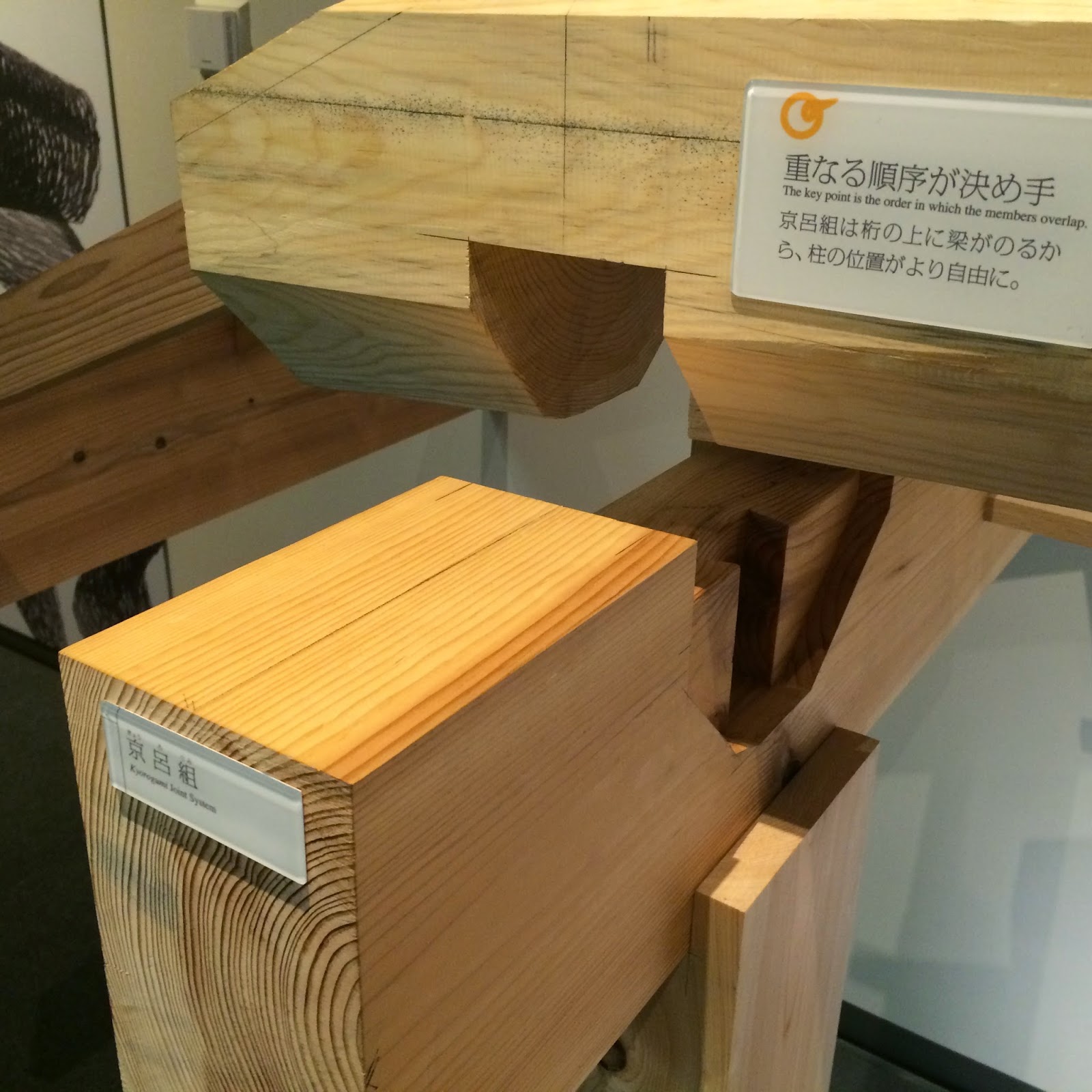 |
| A shouldered sliding dovetail bridle (kyorogumi) joint. |
Tuesday, February 10, 2015
Teaching
I am in the process of applying for several teaching jobs at the college level. One of the standard documents that is asked for is a "Teaching Philosophy." Here's mine:
Learning Objectives
I believe that design and making are active not passive. We
must be present, committed, thoughtful and directly involved in the world in
order to become agents of positive change.
To this end, I believe that a solid design education has three parts:
inquiry, making, and aspirational thinking.
Inquiry
When I ask a student why they made a particular choice, they
must unpack their own motives and assumptions.
This helps them to be more critical, more aware and more thoughtful as
they engage in the design process. So often we can be unaware of the questions
we are really asking, and this is especially true in young designers. Students in our senior thesis class (a
two-semester required course), determine for themselves the subject of their
individual projects. The only
stipulations are that the thesis must be applicable in Syracuse NY and respond
to a demonstrable need in this locale.
This encourages them to directly engage local communities, to research
existing social and cultural conditions and to think critically about their
response to those conditions. Students
guide their own studio work through discussion with each other and with the
other stakeholders in the project.
One process that I began implementing three years ago as a
research tool is a volunteering requirement. Each student is required to
volunteer for at least 25 hours with a group or organization in Syracuse. This gets them “out of the bubble” of our
University and into the community that surrounds us. For many of our students this is the first
time that they have spent any time with people from a socio-economic background
that differs from their own. By adding
this set of first-person experiences to their academic research, they are able
to create richer and more responsive designs as a part of their thesis work. One student wrote in an end-of-semester
evaluation “I had no idea about the assumptions I was making until I spent time
with [a client at the Food Bank]. It
really changed my design and it also changed my life.” This is slightly grand perhaps, but this
student’s ultimate design did shift from a relatively shallow redesign of a
community center/soup kitchen into an examination of food systems in Syracuse
and an exploration of food inequities.
This act of asking, this process of inquiry is not an isolated
step in the design process or the learning process. All the way through it is imperative that we
step back and look critically at the questions we are asking. I create opportunities for our students to
present their questions to their peers, to me as a faculty member, and to
visiting lecturers as a way to ask, “are the questions I am asking really the
questions I should be asking?” This
process of research and evaluation is carried through the entire design process.
Making
Making is important and relevant and irrespective of
discipline everything we design must be made by someone somewhere. I love
making of all types, and I am vocal about that. The deeper each student’s
understanding of which making, manufacturing, and building processes can be drawn
upon to realize their design, the more complete their design approach is. To
this end, whether it is in my interior design first-year studio, my senior
thesis studio, or my furniture design classes, making is built into the
syllabus. There is an attention to detail and a respect for precision that is
taught better through the end of the finger than through the eye and the
ear. Though cutting cardboard may seem
trivial in the grand scheme of a design education, there is a patience and
precision and response to material that is learned by doing that can not be
adequately communicated with lectures.
In the process of making models in first-year studio the students learn
these skills (patience and precision) as well as learning that there are limits
to and possibilities provided by each material.
These limits and possibilities are a part of our design lexicon, they
enable us to do the work that we do and to do it beautifully and well.
This process of practice extends beyond objects and spaces
and into relationships. Every design is
about relationships, and cultivating those relationships is an important part
of our job as a designer and as a teacher.
When the students are doing their volunteer work, they learn by
experience this first-hand: They must
listen respectfully and critically, often having to go to great lengths to
tease out information that they can apply to their design. This making of relationships is an important
skill that is (like cutting cardboard) best learned by practicing, inside and
outside of the classroom.
In my own work I have spent years learning to be keenly
aware of the material I work with, its origins and its story. It is important to me to put that story into
the finished piece somehow, and to communicate it to the clients or users. I believe that this helps the user connect to
the finished piece and gives it a higher personal value, and it is my hope that
a higher value leads to a diminished chance that the object will be cast aside
and added to the waste stream. This awareness of our place in the cycle of
creation (as users and waste creators) colors every design decision I make,
from materials to processes. It drives
me to seek out methods that have the smallest possible negative impact
environmentally, economically, and socially, and the greatest positive
impact. It also drives me to communicate
this thought process to my students.
This method of thought spills over into my teaching of course: There is no shred of knowledge, no bit of
experience that cannot be utilized as an educational tool. The way that leaves fall off of a tree in
autumn, the way two people pass each other in a hallway, the relationship of
bone to muscle to skin in our hands, all of these are clues to the way the
world works. We can use these as
signposts when we engage in our creative process; we can let them lead us to a
more thoughtful, appropriate finished piece.
Aspiration
I believe that what we do as designers and makers is
important; it will change the world.
Even something as simple as making a mark on a piece of paper changes
the world from a world without that mark to a world with that mark. If this is
true, if every design perforce changes the world, I believe we have a
responsibility to do that in a positive way.
I believe that by teaching students the art of inquiry and the craft of
making I am able to help widen what I call the student’s “field of view.” We can easily fall into the trap of thinking
too narrowly, of ignoring the interconnected nature of the world around
us. But every choice we make has effects
that ripple outward, and choosing one material (for example) over another or
one construction method over another can have profound impact on all manner of
other disciplines and industries. To this end, I pursue projects for my
students that respond to that agenda, seeking out socially and environmentally
responsible real world clients like e2e Materials (a local sustainable-product
business), or community gardens and other community centers.
As field of view broadens, as we become more aware of the
interconnected nature of the things and processes and people in the world
around us, we are able to identify and mitigate the relationships that we are
working to improve in a much more sensitive way. Sometimes this process is simple: Critiquing a first-year student’s drawing and
noting the lack of crown and base molding in the drawing can lead to a
discussion about the role of molding in an interior first as way to keep out
the cold, then as a status symbol, then (by doing away with it altogether) as a
Minimalist statement about æsthetics.
Other times it is more complex: a
discussion with a thesis student about generational poverty leads to insights
about the role that government-built housing (built cheaply and often with
little thought about the relationship of the residence to the end user) can
play in underlining and even creating attitudes about class-identity and
self-identity.
These three components (inquiry, making, and aspiration) are
not steps in a process, rather they are twisted around each other like strands
in a rope: they start together and
support each other and run concurrently all the way through the process
arriving together at a student who graduates engaged with the world, looking
critically at that world, and ready to make positive change within that world.
Thursday, November 20, 2014
Haptic Learning and De-Skilling
A really well-written blog post has been making the rounds over the last few days that addresses "de-skilling" the arts. I suggest you go read it, it is not that long and it is really well written. A friend posted it to my FaceBook page asking what I thought about it, and I thought I should put my response over here as well to make sure I could get to it again:
"Well, I have a lot of thoughts about it. I think it is very well written, and presents the situation in a refreshingly neutral way. Of course I (like many of my colleagues) do my fair share of fist-shaking and rending of garments and bemoaning the loss of haptic experience. But the reality is that generational experiences have always differed (in the "I don't see what is so all-fired exciting about this new-fangled 'pencil' all the kids are talking about! It's just a phase. Who needs that kind of flashy gadget?!?" sense).
I am interested to see how the generation that I am teaching now figures out to process the world. I process a lot through touch, you see. The feel of material in my hands, the way a plane feels when it moves across the top of a piece of wood, the vibration of the back of a guitar through my skin and against my rib cage. This is how I process the world, and it makes sense to me.
But then it makes sense to me that there are whole steps and half steps on a piano keyboard and nothing in between, but a Japanese musician would take real issue with that. They would be aware of quarter steps between each whole note and the sharps and flats on either side, and they are perfectly correct given their understanding of and filters on the world.
So what does this mean? Who knows? But we have been genetically humans for many hundreds of thousands of years, and have had new-fangled inventions like writing and clothing and farming and steel and electricity and houseplants and rugs and ice cubes for a tiny tiny fraction of that. So NONE of us know what it means to us to have computers.
All I can do as an educator is guide my students as best as I can to a broader understanding of the world they are moving through. I do that by showing them how I work with my hands, but often they show me their ways as well, and I think we are both bettered by that process.
In the end, I guess I think two things: We can not put the digital genie back in the bottle even if we want to. And progress is always made by engaging in thoughtful conversations across boundaries. In this case it is across generational boundaries, I think."
There is a tendency to be over-glib on FaceBook, but the underlying sentiment is one that I have been thinking about quite a bit over the last year as I have been tasked with leading a group of faculty who are putting together a First Year Curriculum for the Design School at the university where I work.
More later I hope.
"Well, I have a lot of thoughts about it. I think it is very well written, and presents the situation in a refreshingly neutral way. Of course I (like many of my colleagues) do my fair share of fist-shaking and rending of garments and bemoaning the loss of haptic experience. But the reality is that generational experiences have always differed (in the "I don't see what is so all-fired exciting about this new-fangled 'pencil' all the kids are talking about! It's just a phase. Who needs that kind of flashy gadget?!?" sense).
I am interested to see how the generation that I am teaching now figures out to process the world. I process a lot through touch, you see. The feel of material in my hands, the way a plane feels when it moves across the top of a piece of wood, the vibration of the back of a guitar through my skin and against my rib cage. This is how I process the world, and it makes sense to me.
But then it makes sense to me that there are whole steps and half steps on a piano keyboard and nothing in between, but a Japanese musician would take real issue with that. They would be aware of quarter steps between each whole note and the sharps and flats on either side, and they are perfectly correct given their understanding of and filters on the world.
So what does this mean? Who knows? But we have been genetically humans for many hundreds of thousands of years, and have had new-fangled inventions like writing and clothing and farming and steel and electricity and houseplants and rugs and ice cubes for a tiny tiny fraction of that. So NONE of us know what it means to us to have computers.
All I can do as an educator is guide my students as best as I can to a broader understanding of the world they are moving through. I do that by showing them how I work with my hands, but often they show me their ways as well, and I think we are both bettered by that process.
In the end, I guess I think two things: We can not put the digital genie back in the bottle even if we want to. And progress is always made by engaging in thoughtful conversations across boundaries. In this case it is across generational boundaries, I think."
There is a tendency to be over-glib on FaceBook, but the underlying sentiment is one that I have been thinking about quite a bit over the last year as I have been tasked with leading a group of faculty who are putting together a First Year Curriculum for the Design School at the university where I work.
More later I hope.
Friday, May 31, 2013
Tools Abroad

We also are getting to spend a fair amount of time with tools and the way things are made, which I also love, and which is new for a lot of these students, as it turns out. It has been exciting to see them get excited about making and about the idea that they can make stuff. And I get to also see some incredible stuff, of course.
The story goes that in 1610, a temple carpenter in Nagoya started a carpentry business named after himself, Takenaka. Today the descendants of Masataka Takenaka run one of the five biggest architecture and engineering firms in the country. When they say it is a family business they are not lying. In about 1985, the corporation decided that it was worried about the decline of traditional wood working and carpentry in Japan and started a museum dedicated to wood and wood working tools.
Holy crap.
When the Japanese get it in their heads to do something, they don't ever really go halfsies. The Takenaka Carpentry Tools Museum is one of the finest museums of any type that I have visited anywhere ever. It rivals the Henry Ford, it rivals the Smithsonian. The displays are in Japanese and English, they are thoughtful, they are interactive, they are well thought out. It was just a joy to be there. There were video demonstrations of things that the students otherwise would never have seen, like two people using a saw to make lumber out of trees. There were displays about making tools. There were different species of wood with plane shavings that you could smell. I mean, if I had several million dollars and a year I could could not have set up a better shrine to traditional Japanese carpentry. Also? There is a full-time staff of six architectural historians.
PEOPLE! Come to Kobe! Go to this museum!
Actually, they are doing a joint project with GSD at Harvard next year, and part of the collection will be there. So go there, if you can't come to Japan.
There is a reverence and a gentleness to the way that the tools are shown that came through to me, an idea that there is something that is still relevant and necessary about these tools. And every edge tool was meticulously sharpened, something we would not do in the States, which betrays a nuanced difference between attitudes: in the States I think we would want to preserve the object in the moment it came to the museum. In Japan, at this museum, it was clear that the displays were put together by people that saw these tools as living objects. They have a purpose and a use, and as Miya-Daiku Ogawa says in a video there "Sharp tools don't lie." You would no more display a dull chisel than you would display a 1903 Harley-Davidson with square wheels on it. It just would not work that way, and this is an object that is made to work. So you show it the way that it would be if it was working.
It is a difference in stance that I have commented on here before, this idea of what is "real," what is "historically accurate," and I am really interested in it. History, of course, is notoriously subjective. It is, as the famous quote goes, written by the winners. And so who are we to say what the best way to celebrate and present history is, and how best to talk about it? Is it lying to say that a building that was built this year is the exact same building that was built a hundred years ago, if it was built in the same way with the same tools? Not from a certain (very Japanese) point of view. Similarly, it is only appropriate to sharpen a plane iron to a mirror hone before presenting it.
I suppose that one of the things about travel is that it allows you to step back and look at the assumptions that you make every day and question them. I sure am doing that here, sometimes on a daily basis. Here are some images from the museum.
 |
| Two-person saw with an instructional video. There was also a video about how to assemble the saw. |
 |
| A "Standard Carpenter's Tool Chest" |
 |
| A display of sumitsubo, which they use instead of chalk lines. |
 |
| A very funny Indonesian wooden hand plane. |
 |
| "Woods of Japan" complete with end grain, face grain, and shavings to smell. |
 |
| Adzes. Lots of adzes. |
 |
| More joint samples. |
 |
| Yet more joint samples |
 |
| "How to make a ryoba saw." |
 |
| "A Miya-Daiku's Tool Chest" |
 |
| The different finishes and the waste that comes from using an adze, a spear plane, a roughing plane, and a hand plane in that order. Holy cow |
Sunday, May 19, 2013
Ma
 There is a concept in Japan that is called ma. The ideogram is shown to the left there, and though I am not a Japanese scholar I have it on good authority that what we are looking at is the ideogram for "gate" or "door" (the two parts to the left and right) and the ideogram for "sun" (the square in the middle). So the ideogram shows light shining through a space between objects, which is exactly what ma is: a gap, an opening, a space between two things, a silence.
Ma, I am learning, is one of those concepts that does not easily translate cleanly into English, but it is a beautiful idea, and one that as a designer and maker I am falling in love with. It is what the quote by a famous musician (which I always heard attributed to Miles Davis, but the internet variously attributes to Claude BeDussey, W A Mozart, and a Zen koan) means when it talks about music being "the silence between the notes." That is ma.
I am intrigued by the idea that beauty might not just come from an object, it might come from the space between objects. That is, that emphasis is taken off of the object itself and transferred to a non-object, a space, energising it to the point that the space becomes object-like, if you take my meaning. This does not diminish the import of the objects on either side, in fact it increases their importance, because the ma that is created depends heavily on what it lies between.
Robert Edmond Jones, father of American set design and still a hero though I am no longer involved with the performing arts, wrote that "A chair is just a chair. It is in the arrangement of the chairs that the magic lies." He was getting at this same idea, I think, this idea that everything is contextual. A chair can be perfect or terrible depending on the context we find it in, and empty space can be useless or beautiful depending on what lies on either side of it.
So ma.
 We have been visiting a lot of gardens, and it is in these miniature worlds that the Japanese are so fond of creating that I am coming to be a real lover of the idea of ma. The tension of a branch hanging over the water is something that I had noticed before as being beautiful, but had not known was a concept in itself, a specific way of creating beauty in a thoughtful and considered manner. Now that I am paying attention to it, of course, I am seeing everywhere (like when you have your first kid and suddenly you see babies everywhere), often in gardens but then also in other places as well.
 This is in the gardens of the Imperial Villa at Katsura. Here I see the ma in the space between the bridge and the reflection of the bridge. The space of the ma is made more beautiful because it is part real and part illusion, part real-world and part reflected world. This made me stop and stare for so long the person behind me on the tour walked around me.
All of these gardens are so carefully designed that I forget sometimes how specifically they have been orchestrated. Not that there is any pretense that they are natural growth, rather that as a teacher said to me once "the best design is the design that is so right and so well-thought out that you are not immediately aware of it at all." That is what is happening in these gardens: I am not immediately aware that they have been designed, because the sense of beauty and attention to detail is so pleasing that I forget momentarily to be aware of them as designed spaces.
 Here is the fountain at Kiyomizu-deru, I think I posted this one already. The water could have been left to fall naturally down the rocks, but by being routed through the three troughs and let to fall into the basin below we become acutely aware of not just the trough and the basin but also the space, the air, the distance that the water falls and the form it takes as it does so and the sound it makes as it lands. That air is so important to the whole experience, the beauty encoded in it is what is central to this waterfall, almost more than the water itself.
Okay, last one and then I am done. This is the beam that I posted the other day, also from Kiyomizu-dera. Looking at it as an object about ma, the space in the joint becomes so much more evocative. When I posted this photo before it was about the joint and about the history of it and of the temple and of the person who made it, but looking at it in this light, the hole (called a mortice) becomes beautiful in its own right, evocative and sad and lovely. Beautiful and eloquent in its emptiness.
And of course this gets me to thinking about the space between people, and about how that can be appreciated and used thoughtfully and even celebrated. This idea that objects or people have identities but that the relationship between those identities and the new identity that is created when the whole package is considered has a relevance when I think about the community-building work that I have been doing. It is helpful to me to think about in those terms.
So much good stuff here.
Thursday, May 16, 2013
Shiorian Museum

 | ||||||||||||||||||||
| One of our students in a yukata. |
The structure is a text-book example of a machiya or wooden town house. Beautiful structures, the kyomachiya (or Kyoto machiya) is considered the defining form of the city version of what are collectively referred to as minka, or traditional folk dwellings. The other minka form is the noka, which is the farmhouse, and we will see some of those later in the trip.
The Shiorian is a late Edo period machiya, beautifully preserved and accessible to the public. It is a particularly complex one, with a built-in tearoom, two gardens, and a big store-house in the back. The floor is all tatmi mats, woven grass over a frame that has a little give when you walk on it. One of the things I am finding out about this practice of constantly removing your shoes when you enter buildings is that it really gives your feet a rest when you are out walking all day. That change of context really helps rest one's feet, it is quite nice.
The interior is all wood and paper and grass, with very little paint, which has two effects that I really love: One is that I find it restful to be completely surrounded by natural materials in their more-or-less natural state. The other is that the spaces have a smell. It smells like, well, like wood and grass. Not like being in a forest, and not in a bad way, just that there is a perfume to the interiors that adds to the pleasure that I feel being in the spaces.
Traditional Japanese houses layer the views in a way that we don't tend to do in the West. No matter where you sit in the house there are a series of planes that recede in front of you, and with the shoji open there is nowhere that you can sit that you can not see at least one of the gardens.
And the gardens are amazing.
Little worlds in miniature, they have all of the small twisted trees and moss-covered rocks that you would expect to see. Sitting still and contemplating the garden sounds boring, maybe, especially to a 21st century Westerner. But I am here to tell you that I could do that all day. The sun moving is the channel change, the breeze blowing the leaves reveals new content like opening a new window on your browser. I was captivated for far longer than I would thought possible. It was surprising and lovely to just sit and look at a beautifully composed garden. The photographs can not possibly do it justice, you really have to be there, sitting on the tatmi and smelling the interior and watching the sun change on the trees.
A quick word about the shoji before I sign off: They were amazing. Having read so much about them and about how to make them, it was a real treat to have a chance to get up close and personal with them. Knowing that each piece was cut and planed and installed by hand by some long-dead tategu-shi really knocked my socks off. The bevel on each one was perfect, they all matched, the joint were tight, it really is a testament to what is possible when there is care and thoughtfulness and pride in one's work. And they slide effortlessly in their tracks. What a joy.
 |
| A really lovely column in the tea room. |

 |
| Shoji. Enough said. |
 | |
| The rear garden |
 |
| What, you ask, is "FIRE GOLD?" Ice coffee with milk and sugar in a can, obvs. Brought to you by your friends at Kirin. The Asahi brand of the same thing is called "BOSS." Neither are particularly good, but if you have to choose, choose FIRE GOLD. |
Wednesday, May 15, 2013
Kyomizu-dera

So when you are talking about visiting Japan and if you are going to be anywhere near Kyoto, you visit Kiyomizu-dera. If you are in Japan and you are at all interested in wood and wooden structures, you make a point to go to Kyoto so you can see Kiyomizu-dera.
So we went yesterday to Kiyomizu-dera, obvs.
Built in the early 1600s, Kiyomizu-dera is a Buddhist temple built on the side of the incredibly steep mountains that surround Kyoto. The temple is built around a waterfall ("Kiyomizu" means "clear water" in Japanese), and the washing of your hands and drinking the water from the waterfall is supposed to have wish-granting powers. And maybe it does.
The approach to the temple is through some very old streets (and by old I mean old in a way that we don't have a context for in this country) small and winding and so picturesque that it kind of hurts. Lots of beautiful wabi-sabi, lots of beautiful wood work, some pretty great stone work, and all impeccably clean. So clean that it looks like a 1950's movie set, like we are somehow in a Japanese version of "Singin' in the Rain" but with the singing or the rain. Or Gene Kelly.
So up the side of the mountain we trek, and the temple slowly reveals itself to us. The first thing that you take in is the crowds. Thousands of school children, mostly middle schoolers, each in their school uniform and all wearing matching bright yellow or red or blue hats, pushing and laughing and talking in the way that middle schoolers everywhere do. Comforting to know that some things about being human are constant. And they are all on field trips, apparently, to see the temple. The nice thing about being in crowds of middle schoolers is that you can still see everything, because they are mostly still short, you know. So there is this swirling tide of yellow and blue and red caps at about nipple height, but you can still see all the things you want to see. Which is nice.
As you pass the torii gate and go into the temple complex itself, you become aware of the timbers.
Well, I become aware of the timbers. Because the thing about Kiyomizu-dera is that it is built with out nails. It is all timber-framed joints, all fit so carefully that in general you can't slide a piece of paper into the joints. And these are no 12" x12" timbers like one might see in the kind of timber-framed structures that I have been in, these are massive columns, 24" round. It really is quite stunning to be in front of. I have to work very hard to keep the sides of my mortices straight in a 2" thick table top, the kind of precision required to cut a tight mortice through a column of that size really gave me pause.
As soon as I walked inside I heard an inconsistent beautiful low gong being rung. The practice in temples is that one makes an offering, then makes a prayer to the Buddha, then rings a bell. I have been told that the idea is that the bell wakes up the god and reminds them to grant your prayer, but I don't know if that is true or not. Maybe. I kind of like the idea of the god snoozing away and being startled awake by the bell. He rolls over, grumpily waves his hand to grant your prayer, and then drifts back off to sleep with a snort. It's a nice image, and I like the way that ringing the bell punctuates the acts for the devotee. Nice to have that kind of theatrical button on one's prayer-making. Not sure I would want my prayer granted by someone who just woke up, though. I tend to be grumpy and clumsy. You might pray for a new car and get one because yours gets totaled with you in it, you know what I mean? Clumsy prayer-granting. And that may not even be the reason to ring the bell.

 But this bell, holy cow. It is a massive bronze bowl, maybe 42" in diameter at the rim, and it is struck with a rope-wrapped (say that five times fast. Bet you can't) mallet. And the sound is unbelievable. Low and long, with lots of sustain. I stood there for a while and just listened to it be rung and enjoyed the hell out of it myself. I wanted very badly to ring it, but I did not feel right doing so. I am sure thousands of non-Buddhists ring it every year, but it felt disrespectful. So I stood and listened for a while and let the incense waft over me there in the mid-gloom of this five hundred-year-old wooden structure. The sound of the middle schoolers outside swirled around me like the incense, more intense at time and less intense at times. The bell gonged intermittently, and the growing heat of the day made the wood smell just amazing. What a lovely place. When it is quiet and free of people I can only imagine that it is serene in the extreme.
As amazing as the temple is, the real money is underneath. The porch of the temple is about forty feet off of the ground because of the extreme slope of the hill, and there is a famous (well, famous to me, anyway) lattice work of beams and columns that hold it up. All timber-framed, all hardware free. It is unbelievable. The amount of effort and time that it took to get those beams there and marked and cut and fitted beggars definition. The hands and minds and work of a lot of woodworkers went into making that happen, and I was gobsmacked to be finally standing in the presence of all of that. Talk about a holy place. It is a monument to working with our hands, to what humans can do when they have a mind to. We can accomplish pretty incredible things when we work together.
As I stood there with one of my students, he asked how old the temple was, which was hard to answer. In the states, we have ideas about originality, and what identity means for objects that is different here. The Shinto Ise Jingu shrine, for example, is rebuilt every 20 years as a testament to death and rebirth, and as a way to train temple builders. But if you ask the priest how old the temple is, he will say it was built in 4 BCE. It is rebuilt in exactly the same way every time, using the same methods and the same type of wood, so it is the same exact shrine, if you see what I mean. Not a new one built on the same plot of land in the same way, but the same shrine. Interesting way of looking at it. Brings to mind all kinds of questions about "thingness," and what the identity of a thing is, and how we judge that.
So answering my student about the age of Kiyomizu-dera becomes tricky, you see. On display there were some chunks of what were clearly old beams that had been replaced. I could not read the signage, but it clearly said something like "This used to be a part of this temple and we replaced it." So the actual beams may not be as old as the 1630's. But then the Japanese will say unequivocally that yes, this temple was built in the 1630's, and who am I to say they are wrong? After all, what matters here? When it was built? How it was built? Why it was built? Hard to say. What really matters, I suppose, is that it was built, and that we can come here to see it and hear it and smell it and generally be given a moment to pause and reflect on the human condition and our role in the world and where we feel our energy would be best used.
 |
| Middle Schoolers doing what they do best on a field trip: Making noise and running around. |
 |
| This used to be a part of the temple. You can see the chisel marks on the bottom of that mortice. Humbling. |
 |
| This is the sign above that old chunk of beam. I think it says something like "This beam used to be a part of the temple but we replaced it." |
 |
| A holy sight worthy of a pilgrimage. |
 |
| Little roofs on the beams protect them from weather. |
 |
| The support lattice from below. There used to be a superstition that if you jumped and survived your wish would be granted. Wikipedia notes laconically "Two hundred thirty-four jumps were recorded in the Edo period and, of those, 85.4% survived. The practice is now prohibited." |
 |
| The clear water waterfall that gives the temple its name. Tastes pretty good. And wish was already granted, because I am here. So the wish-granting thing works, obviously. |
Subscribe to:
Posts (Atom)