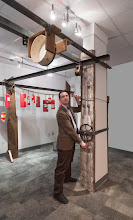
a letterpress designer, an itinerant copy writer, and a furniture maker are sitting around a fire...
This sounds like the beginning of an irrepressibly nerdy joke, but as it happens this was Friday morning last week. One of the things that I am profoundly thankful for in my life is that my path seems to cross others' in unpredictable and delightful ways. So Friday morning last week I ended up sitting and talking to two people that it is unlikely I would ever have crossed paths with about something that turned out to be a common thread and a common passion: Craft.
Casey McGarr, who has a truly dizzying array of old wood type (and you know how I feel about wood) told us that many people turn to him for letterpressed invitations or cards with the expressed explicit desire that the type be smashed into the paper "so people know that it is letterpressed." I can understand this thought process, I suppose. So many of these once-necessary-now-nearly-defunct crafts face the same kind of requests, this idea that the process should be evident in the product so that the user or viewer will know how the object was produced. I do this in my own work as well; leave plane marks evident, or celebrate jointery or hardware to make a point and to use my work as educational tools for the user.
The thing about that kind of approach is that it is actually antithetical to the traditional intention of artisans who use this technology. A good letterpress operator will know how to adjust the press so that the type just kisses the paper enough to transfer the ink but not enough to deform the paper. This is exactly the same as blacksmithing, for example. George Martell, the smith who gave me what few smithing skills I have, told me that a good smith never leaves a hammer mark, that a piece that is well made is smooth and straight and shows no marks at all of the process of making. Or of songwriting: if the lyrics are too clever (say Gilbert and Sullivan, for example) we become aware of the cleverness of the writing but can lose sight of the intended message.
Which begs a familiar question: What is the point of all of this, process or product? It could be both, I suppose, but this is another one of those root questions that I come around to now and then that does not seem to go away. How can I as a maker celebrate the process and materials in a way that feels honest and clear while at the same time creating an object of beauty and use? When am I smashing the paper, and when am I making a legitimate statement about my stance as a maker and about my respect for tradition?
When I wrote about Pye and his bowls not too long ago, I was trying to unravel a different part of the same question, which at the end of the day might be about means and ends as much as it is about process and product. Whichever way we come at this question, though, it comes down to intent, and to methods of work, and to choice-making. And it does not seem to go away, which I think is a good thing.
What a lovely way to start a Friday morning last week. And how lucky I was to be able to spend time with folks who are interested in asking the same questions that I am asking. And how very informative to have the questions phrased in unfamiliar language. The Texas trip was great in so many ways.
Wednesday, April 20, 2011


Tuesday, April 19, 2011
travelling
this past weekend I traveled to Texas Hill Country. I spent four days under a cloudless sky out in the wilderness surrounded by (mostly) graphic designers. New territory for me in many ways; geographically, professionally, contextually. It was great fun, and the trappings were outstanding, of course. There was an obscene amount of Texas-style barbecue and other delectables, the country was beautiful in a rocky way, the accommodations were lovely, complete with a hat rack in the room (thank God for Texas and cowboy hats). But it was the contextual territory that was the most interesting for me.
I had been asked to lead a workshop about wood, giving it three times for two hours each. This is tricky, if the desire is to have everyone leave with something. I can spend two hours just turning a couple of planks over and over and switching them end for end to find the right combination of grain pattern and patina, of live edge and machined edge. In the end we decided to make lamps out of locally found dead-fall trees, which ended up being pretty successful.
When I have been involved with this kind of workshop in the past, many if not most of the participants have had some experience with making things out of wood and working with their hands in a particular way. That was not the case here. These people were (in many cases) very experienced designers with many years of professional accomplishment behind them, and some are even very used to making books or screen printing (a process that remains opaque to me to this day. Some day I shall have to remedy that), but that have little experience with wood or with wiring. Not that they should, of course, that is why they were in the workshop.
But by and large these are people who design digitally, and design for print. Their application of their craft and their design skills has a radically different user interface and a profoundly different expectation in terms of life-span, usually. As we all worked, and as they grew comfortable exchanging a mouse for a screwdriver, an amazing and heartwarming shift began to occur. As each person plugged in their nascent lamp to test it, their faces registered delight of a level that really moved me. Many of them went from "I am not sure I can do this at all" to "I want to make everything into a lamp!" And the really amazing thing is that by the end, many were helping their fellow students, showing them how to use the crimper or to wire in an in-line switch, people who two hours before did not know what an in-line switch was.
This starting to sound self-serving, which is not my intention. This shift that happened, this empowerment (pun intended) of all of these people, is less about any ability that I have and more about something much more important and profound: A willingness to learn. I have taught this information to hundreds of NYU students, only to look up and see them drooling on their t-shirts. It isn't about the information, it is about being receptive. The 60 or so people that I spent time with this weekend came to the class with something that can not be bought or sold, and that can not be injected from an external source. They wanted to learn. They were invested in their education for those two hours. They sat down from a place of "I'll try that" instead of "I can't do that." It was really inspiring. This experiment would have been a dramatic failure without that attitude on their part coming in.
It served as a real object lesson for me with regard to changing contexts. There is such a tendency on my part (and on many people around me) to approach the world saying "I know my place here and I know what I do well, and that is what I am going to do." This is often a reasonable approach, and certainly is a comfortable one, like putting on a straight-jacket that you know and love. Comfortable, but ultimately stultifying as far as growth. Change is hard, of course, and new experiences can be painful or scary. But I am inspired to adopt the attitude of the people I was so recently surrounded with to try to maintain that openness, that desire to learn new things, and the willingness to take on things that are likely to fail, simply because when they don't fail the triumph is that much greater.
I had been asked to lead a workshop about wood, giving it three times for two hours each. This is tricky, if the desire is to have everyone leave with something. I can spend two hours just turning a couple of planks over and over and switching them end for end to find the right combination of grain pattern and patina, of live edge and machined edge. In the end we decided to make lamps out of locally found dead-fall trees, which ended up being pretty successful.
When I have been involved with this kind of workshop in the past, many if not most of the participants have had some experience with making things out of wood and working with their hands in a particular way. That was not the case here. These people were (in many cases) very experienced designers with many years of professional accomplishment behind them, and some are even very used to making books or screen printing (a process that remains opaque to me to this day. Some day I shall have to remedy that), but that have little experience with wood or with wiring. Not that they should, of course, that is why they were in the workshop.
But by and large these are people who design digitally, and design for print. Their application of their craft and their design skills has a radically different user interface and a profoundly different expectation in terms of life-span, usually. As we all worked, and as they grew comfortable exchanging a mouse for a screwdriver, an amazing and heartwarming shift began to occur. As each person plugged in their nascent lamp to test it, their faces registered delight of a level that really moved me. Many of them went from "I am not sure I can do this at all" to "I want to make everything into a lamp!" And the really amazing thing is that by the end, many were helping their fellow students, showing them how to use the crimper or to wire in an in-line switch, people who two hours before did not know what an in-line switch was.
 |
| Some of the student work. Photo by Andy Birdwell |
It served as a real object lesson for me with regard to changing contexts. There is such a tendency on my part (and on many people around me) to approach the world saying "I know my place here and I know what I do well, and that is what I am going to do." This is often a reasonable approach, and certainly is a comfortable one, like putting on a straight-jacket that you know and love. Comfortable, but ultimately stultifying as far as growth. Change is hard, of course, and new experiences can be painful or scary. But I am inspired to adopt the attitude of the people I was so recently surrounded with to try to maintain that openness, that desire to learn new things, and the willingness to take on things that are likely to fail, simply because when they don't fail the triumph is that much greater.
Wednesday, April 6, 2011
tools
most people that make furniture know who David Pye was. He was a Professor of Furniture Design at the Royal College of Art from 1948 to 1973, and in 1968 he published "The Nature and Art of Workmanship," which is still one of the key treatises addressing what we call "workmanship," or craft. I was turned on to the book by Craig Vandall Stevens, who told me that it was the single most important book in his life and that it was very important that I read it. With that kind of endorsement, how could I not check it out?
The discussion in the book is primarily about the place of machines in the making process, and their appropriateness given the desired outcome. Pye coined the terms (and I feel a need to acknowledge the implicit sexism contained in the word "workmanship." I will be using that word in this essay only because it is the word that Pye used) "workmanship of risk" (a methodology of making that requires a high level of understanding and craft on the part of the maker, and that can be at any time destroyed by the work due to inattention or callowness) and the "workmanship of certainty" (a methodology that is automated to the point that inattention by the worker has a minimal effect on the outcome of the process). It is important to note that this does not necessarily have anything to do with the machinery used, that depending on the context the machinery associated with workmanship of risk can also be used in a piece at the other end of the spectrum. Pye also points out that there are different levels of workmanship that are appropriate and that this appropriateness is also contextual. It would not make sense to apply the type of precision required to make engine parts to the practice of splitting fence rails, for example. Both endeavors require precision (just ask Abe Lincoln about fence rails), but the type of precision that is appropriate for one is not appropriate for the other.
This is all an extremely ham-handed explanation and distillation of this book. I suggest you read it for yourself, it is life-changing. It was for me, anyway. What I wanted to write about here, though, was not necessarily that discussion (although one could argue that a great deal of this blog is focused on that discussion), but Pye's woodworking (above, pictured in his shop).
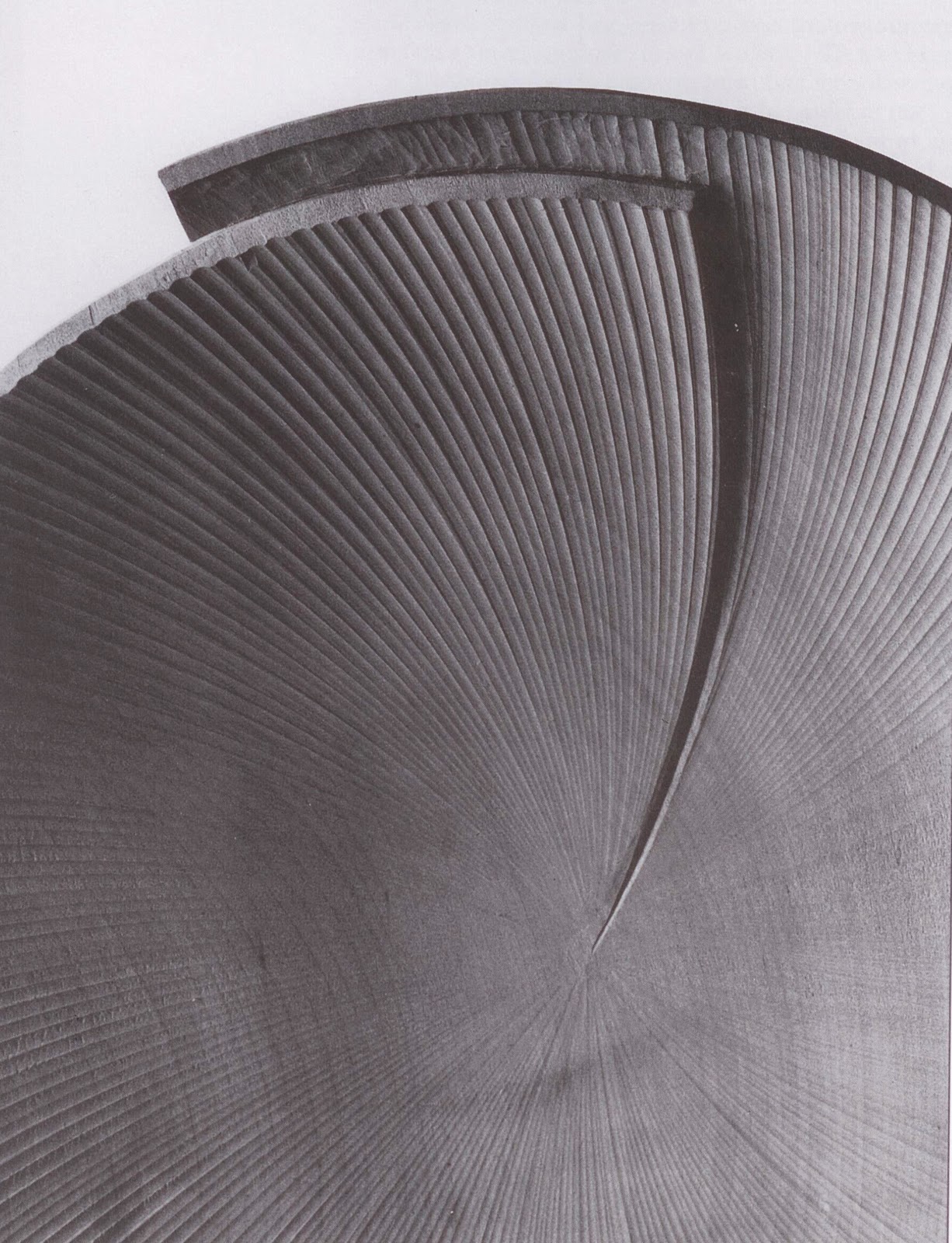
And this is the kind of work that he produced and was known for. He carved these bowls using a nineteenth century tool (I can't seem to find a photo of one on the internet, surprisingly) that made these beautiful gouges that radiate from the center and can be modulated in really breathtaking ways. There are a couple of his bowls in the foreground of the photo above as well. Not all of them are that big, of course, and he experimented widely with the shapes as well, but it is that interior texture that knocks me out. Ever since I first read the book that texture has stuck in my head. Recently I decided to do something about it.
I have had a couple of pieces of long-leaf pine kicking around the shop for a couple of years that are off-cuts from the end of some floor joists from a building on the campus of Trinity College. They are about a foot square, and extremely hard, and they seemed like good candidates for bowldom. The tool that Pye used to make his bowls left that signature tool mark, those radiating lines that start in the center and get wider as they get closer to the edge. I wanted to replicate that mark, and it was important to me that it be the tool that made the mark, that somehow inherent in the making of the object that mark was created. It also seemed to me that this would be a good excuse for me to familiarise myself with our CNC technology and to learn to use a new tool, the drafting program Rhino. Below are some process shots.
Those of you that work with wood will know about the heightened feelings surrounding CNC technology. CNC stands for Computer Numeric Control, which is to say that a computer tells the cutting head where and in what direction and how deep to make a cut in the material. A lot of people that work with wood say that this type of technology is the death of craft (well, of Craft), that it means that anyone can make fancy wood objects, that it devalues the work of people who do not use this technology and that it should be eschewed at all cost. Other people are saying that it is a tool like any other and that it merely needs to be treated like a table saw, a tool that can help achieve a desired goal, and that the object itself is not inherently bad.
I tend to fall somewhere in between these two points of view. Philosophically, this technology is no different from a table saw. It is motorised and can be used to create a very high degree of precision. It requires thoughtful attention to make it do what the user wants it to do, and in the hands of a less skilled worker it can be worse than useless. It makes repeating an operation easy and easy to do in a way that the finished product is identical every time. It (like a table saw) is a tool that gives form nicely to "workmanship of certainty." So why does it feel so different to me?
In no small part it probably feels different because it has become popular and readily available in my lifetime. The table saw was invented in the 1850's by a Shaker woman, it has been around as long as anyone I know can remember. When I started making things professionally, the table saw was already an integral part of the wood shop. I have never seen a professional shop without one. On the other hand, I had not even seen a CNC mill until I was in my mid twenties, and had been making things for a while. So there is that.
 I am happy with the finished bowl. I feel like it is a craft object. I spent as much or more time setting up the file and then the machine as I ever did to mill and cut the wood for the table that the rest of this particular long-leaf pine became. I did a lot of thinking about proportion and line and form, as much as I would do if I were carving this bowl by hand. And the bowl sits on our dining table (the top of which I planed by hand in a very laborious way) and every night I enjoy its presence as we eat.
But for me something is lost in this particular amount of remove between the maker and the material. I am used to my interaction with my material being modulated by a saw handle or the butt of a chisel. I am even used to that interaction being filtered through a power tool, a router or a jigsaw (in fact, that was was a great deal of my interaction with material for the entirety of my life in theater). Having that interaction modulated by a computer screen, on the other hand, feels too distant for me. I do not think that having that amount of remove makes for a finished object of less craft or even that the finished object has less emotional resonance. For me, in my making process, it is important for me to have a specific relationship with my material, one that is not modulated through a computer.
This may change over time. It probably will. But as I think about my growth and about my making that is where I sit for the moment.
 |
| Photo: Phillip Sayer/Crafts Council |
 |
| Photo: David Pye/ Crafts Council |
And this is the kind of work that he produced and was known for. He carved these bowls using a nineteenth century tool (I can't seem to find a photo of one on the internet, surprisingly) that made these beautiful gouges that radiate from the center and can be modulated in really breathtaking ways. There are a couple of his bowls in the foreground of the photo above as well. Not all of them are that big, of course, and he experimented widely with the shapes as well, but it is that interior texture that knocks me out. Ever since I first read the book that texture has stuck in my head. Recently I decided to do something about it.
I have had a couple of pieces of long-leaf pine kicking around the shop for a couple of years that are off-cuts from the end of some floor joists from a building on the campus of Trinity College. They are about a foot square, and extremely hard, and they seemed like good candidates for bowldom. The tool that Pye used to make his bowls left that signature tool mark, those radiating lines that start in the center and get wider as they get closer to the edge. I wanted to replicate that mark, and it was important to me that it be the tool that made the mark, that somehow inherent in the making of the object that mark was created. It also seemed to me that this would be a good excuse for me to familiarise myself with our CNC technology and to learn to use a new tool, the drafting program Rhino. Below are some process shots.
 |
| This is the raw material You can see the triangle-shaped area where the surface of the wood did not oxidise because it was set into the wall of the building. |
 |
| This is the file in Rhino, which is the drafting program we use here. |
 |
| I started by surfacing the material and getting all the sides square to each other and the bottom of the piece |
 |
| This is the material on the CNC router table. |
 |
| The machine started by surfacing the top of the blank. |
 |
| The machine starts the way a carver would, by removing the bulk of the material quickly and roughly. |
 |
| Lastly it takes a series of finishing passes. I was able to experiment with different settings to find a tool mark that was pleasing. You can see the scallops that reference the bowls that Pye made. |
I tend to fall somewhere in between these two points of view. Philosophically, this technology is no different from a table saw. It is motorised and can be used to create a very high degree of precision. It requires thoughtful attention to make it do what the user wants it to do, and in the hands of a less skilled worker it can be worse than useless. It makes repeating an operation easy and easy to do in a way that the finished product is identical every time. It (like a table saw) is a tool that gives form nicely to "workmanship of certainty." So why does it feel so different to me?
In no small part it probably feels different because it has become popular and readily available in my lifetime. The table saw was invented in the 1850's by a Shaker woman, it has been around as long as anyone I know can remember. When I started making things professionally, the table saw was already an integral part of the wood shop. I have never seen a professional shop without one. On the other hand, I had not even seen a CNC mill until I was in my mid twenties, and had been making things for a while. So there is that.

But for me something is lost in this particular amount of remove between the maker and the material. I am used to my interaction with my material being modulated by a saw handle or the butt of a chisel. I am even used to that interaction being filtered through a power tool, a router or a jigsaw (in fact, that was was a great deal of my interaction with material for the entirety of my life in theater). Having that interaction modulated by a computer screen, on the other hand, feels too distant for me. I do not think that having that amount of remove makes for a finished object of less craft or even that the finished object has less emotional resonance. For me, in my making process, it is important for me to have a specific relationship with my material, one that is not modulated through a computer.
 |
| Detail of the tool marks radiating from the center |
This may change over time. It probably will. But as I think about my growth and about my making that is where I sit for the moment.
Wednesday, March 30, 2011
resources
I have some traveling to do next month, and am going to be where I would like to have a guitar. But traveling with a guitar is cumbersome on a plane, and I did not want the hassle, so I thought maybe it was time to make a cigar-box guitar, one that I could travel with, that would fit in my suitcase and that would be strong enough to stand up to being thrown around buy the baggage handlers. And then it became a little bit of a game for me to gather the pieces as locally as possible. Here they are:

There is a cigar store around the corner from where I work that sells the boxes for a dollar and donates the proceeds to charity, so that seemed good. For the tail piece (that holds the strings and the end of the neck by the box) and for the nut (the piece at the other end that holds the strings up off the fretboard up by the tuners) I went five blocks away to the Habitat Restore and got a used hinge and an old bolt. The wood for the neck is this beautiful long-leaf pine that was salvaged from a building two blocks from here from support beams that have been standing in pace for a hundred years. I wrote about that here. The thing that came from farthest away was the tuners and the bridge, the piece of wood that holds the strings up off of the box. They came from Beat Street Music in Manlius, twelve miles away. Beat Street is a great local guitar shop, with some really beautiful old and new instruments, and they do repairs as well, so the owner had some old tuners that had come off of some other guitars and an old bridge from a banjo. The tuners don't match and the bridge is a little worn, but they all work well. Here is the finished guitar:

And here is a detail shot of the tuners and the nut (which is a bolt. Which makes me smile):

And here is what it sounds like, the twelve-mile, two-hour, twenty dollar guitar:
Obviously I have some practicing to do, I don't really play slide guitar. But I can learn, and now I have something that I made myself to learn on. I have been listening to a lot of Mississippi Fred McDowell, so we'll see what rubs off.
The other outcome of this exercise, of course, is that it has been a thought experiment about resources and where they come come from and how they are used. Everything in this instrument could have been seen as trash. No one was going to buy those tuners from Beat Street. The cigar box could easily have been seen as waste. The lumber was slated for the landfill and the hardware ended up at the Restore because it was not wanted. But put them all in the same place in a particular way, and they become something very useful, and maybe even desirable. The easy thing to do when looking for a travel guitar would have been to drop a couple of hundred dollars on some mail-order thing that was made in China. But there are alternatives, and they can be pretty cool alternatives, with the bonus that there is an added layer of meaning on the object, an emotional layer that is created by taking the time to source locally and to make the object myself.

There is a cigar store around the corner from where I work that sells the boxes for a dollar and donates the proceeds to charity, so that seemed good. For the tail piece (that holds the strings and the end of the neck by the box) and for the nut (the piece at the other end that holds the strings up off the fretboard up by the tuners) I went five blocks away to the Habitat Restore and got a used hinge and an old bolt. The wood for the neck is this beautiful long-leaf pine that was salvaged from a building two blocks from here from support beams that have been standing in pace for a hundred years. I wrote about that here. The thing that came from farthest away was the tuners and the bridge, the piece of wood that holds the strings up off of the box. They came from Beat Street Music in Manlius, twelve miles away. Beat Street is a great local guitar shop, with some really beautiful old and new instruments, and they do repairs as well, so the owner had some old tuners that had come off of some other guitars and an old bridge from a banjo. The tuners don't match and the bridge is a little worn, but they all work well. Here is the finished guitar:

And here is a detail shot of the tuners and the nut (which is a bolt. Which makes me smile):

And here is what it sounds like, the twelve-mile, two-hour, twenty dollar guitar:
Obviously I have some practicing to do, I don't really play slide guitar. But I can learn, and now I have something that I made myself to learn on. I have been listening to a lot of Mississippi Fred McDowell, so we'll see what rubs off.
The other outcome of this exercise, of course, is that it has been a thought experiment about resources and where they come come from and how they are used. Everything in this instrument could have been seen as trash. No one was going to buy those tuners from Beat Street. The cigar box could easily have been seen as waste. The lumber was slated for the landfill and the hardware ended up at the Restore because it was not wanted. But put them all in the same place in a particular way, and they become something very useful, and maybe even desirable. The easy thing to do when looking for a travel guitar would have been to drop a couple of hundred dollars on some mail-order thing that was made in China. But there are alternatives, and they can be pretty cool alternatives, with the bonus that there is an added layer of meaning on the object, an emotional layer that is created by taking the time to source locally and to make the object myself.
Tuesday, March 29, 2011
knowledge
i was sifting through my email this morning and came across a letter that I had written to a couple of my students at about this time last year (dated Feb 10 2010, or 02 10 2010, which is pretty pleasing). There are some references to things that were happening at that moment, which make it sound dated, but the gist of it is about right. Nothing that I have not written about before, really, but I wanted to put it here for storage, so here it is:
Geek
Our brief conversation this morning in the café has stuck in my mind, and since talking about things is how I get them out of my mind and into the world I thought I would give this to y’all and see what you have to say. You asked me how I know all of the seemingly unconnected little factoids that I know, and though it was probably asked rhetorically, I have been thinking about my answer, and it is a simple one: Knowledge is power.
Not “power” like in a He-Man “By the power of Grayskull I have the power” kind of way where your clothes disappear and you become a hilariously over-muscled super hero in a fur loincloth (fur? Really? Always seemed like a strange choice to me), more like the power to make one’s own choices and to make a positive difference in the world. Think about it.
The group that wields the sacred knowledge is always the group that runs things. In early civilisations this was the shaman or priest or whatever group member stood in in that capacity, the person that held the secrets to the power of the god or gods of the day. These were the decision makers, the rich and powerful, the people who made the rules and (for the most part) had all the money and the good stuff to eat.
Then there are the people who hold the military knowledge, about how best to kill the most people. These are often people who are in control in a culture. It is no accident that the U.S. President is the “Commander in Chief” of the armed forces. He (Hasn’t been a She yet, but I have faith. One day, one day.) is in control in part because he has the knowledge necessary to control the most powerful army in the world. General Mao. Saddam Hussein.
Then there are the more insidious kinds of knowledge that put the holder into powerful positions: How to steal legally (as the major banks did, causing the Recession we are currently enjoying), how to lie legally (as, for example, the corn syrup commercials who say that it is all-natural and good for you), how to disenfranchise legally (as in the misogynistic Superbowl commercials that got me all pissed off that I was railing about in Materials class until I realised you were all just looking at me in that way you do when you are just waiting for me to shut up and get on with it). These are bodies of knowledge that are pretty opaque to the average person, but knowing how to wield them lands one in a pretty sweet position.
So in a culture that has spent so much time and energy trying to breed people not to question, not to think for themselves, not to seek knowledge for the sake of knowledge, the most empowering thing I can think of to do is gather as much knowledge as possible, and to disseminate it to as many people as possible. And then to encourage them to do the same. U. Utah Phillips says “the histories we are given in schools is not the history of MY people. It is the history of the rich, the powerful, the greedy. The only way we can get a TRUE history of our people is to listen to our elders, and to pass on their stories.”
So how is the history of the Hudnoshonee people relevant to Interior Design? Because it is all connected. It has to be. Every choice that we make is made in reaction to what we know. Either what we know through experience, or through reading that we have done, or through stories that we have been told. The more things we know, the farther reaching our design work (and our lives in general) have the capacity to be. And the greater chance we have to make a positive difference in the world, to “play our part,” as Shakespeare says, and then exit the stage.
I have always delighted in knowing things. Any things. It is all relevant. And the best tools you have as a designer are your eyes, to see instead of just looking; your ears, to listen instead of just hearing; and your brain to synthesize it all. You short yourself as a designer and as a person and your society in general, if you do not use all three, all the time, in a thoughtful way.
Wow, this got longer than I intended. And I am not even through. We will have to continue this another time. Have a good weekend. For a gold star, bring me an extremely obscure fact on Tuesday and relate it to your project.
Zeke
postscript: Every time someone calls me “Geek” (which as I told Kennedy this afternoon has long since stopped bothering me as it has been happening since before you were born), I think of someone like this:
Geek

Look up “geek” and you’ll see what I mean.
z
Friday, March 25, 2011
ornament / structure
there is a project on the bench these days that I am not ready to write about yet, but that has gotten me thinking about ornament. I waffle a lot when it comes to ornament, specifically about two issues, I think: What is “ornament,” and what is “function?”
The second question maybe needs to be addressed first as I think of my work as being “function-based” design. That is to say, that I eschew adding elements that are not in some way dictated by the structural needs of the object. Certainly structural needs are one compelling mandate, but there are other aspects that dictate functional needs, and that can influence the finished form.
In the current project, there are aspects that have no structural function, so they led me to question the “functionality” of them at all, and their necessity within the overall piece. In the recurring “form v. function” debate, I tend to think that form and function are like the chocolate and vanilla in a marbled cupcake, that they can not be separated in any meaningful way, that in the best design work there is nothing that one could remove that would not be sorely missed in the remaining piece.
There are, however, functions beyond the purely structural. As I was contemplating these panels and their place in the overall piece, I thought of the bed I made a few years ago and the oak branch that I found on the forest floor that became the lamp-post/headboard:

There are of course a variety of ways I could have kept that corner of the bed off the ground, and there are other ways to solve the need for a reading light. The structural functionality of the base of the oak branch as a leg of the bed or of the rest of the oak branch as a lamp-post are important, but the necessity of introducing an element that had the æsthetic function of providing relief from the relentless straightness of the machined planes is just as important, making the æsthetic choice a choice about functionality as well. Which brings us back to the first question, the question about ornament.
“Ornament” is a dirty word to a lot of designers that I greatly admire. Often it is to me as well. The idea of creating something that is ornamental not an appealing one, and often when I look at heavily ornamented structures or objects I feel that though I may admire the maker I do not want to live with that object or in that structure. That being said, there are of course ways to make necessary structures ornamental. To say the same thing coming at it form the other direction, there are ways to see the inherent beauty in the structure of an object. Japanese hand-laid "washi" paper is a good example of this:

The structure of this paper, that is to say the fibers that are the paper, can be presented as we are used to seeing them in a sketchbook; homogenized and bleached to the point that they appear as one solid sheet ready for the mark of a pencil. But in the paper shown above the fibers are not homogenized like that. They are allowed to have their own life by the maker, they have a voice and an identity. Though decorative, in a way, they do not strike me as ornamental. And they are integral to the paper, they in fact are the paper.
It is this parsing of the line where æsthetic function becomes ornament that I have been thinking a lot about lately. As I make the objects I make, as I develop my teaching, I am navigating the murky waters of ornament and trying to figure out what it is that really resonates, what it is that really needs to be there. I have also been re-thinking whether, in a basic sense, ornament is, in fact, a bad thing.
Because this is really about asking questions about my own life, of course. What needs to be here? What are the things that are (for lack of a better word) “structural” and what is “ornament?” What in terms of emotional and intellectual and physical needs must remain, and what can I strip down, strip away? As I build my life and the life of my family, are there things that are ornamental, and if there are is that okay? And what are the structural needs? Are there moments where emotional ornament is actually structural? And are there ways that I can make the emotionally structural necessities ornamental?
Tuesday, March 15, 2011
appropriateness
as I age (I am occasionally reminded that I am pushing forty) I am mellowing. Though there are things that I believe firmly and fiercely, my overall world view is getting more relativistic as I wander farther into my time on this planet, and many of the things that I once felt stridently about are getting harder to parse, with "right" and "wrong" being less abundantly clear.
In 1997, as I was in my final year of my second undergrad, I took a class from a teacher and mentor and friend named Bland Wade. He runs the Theatrical Properties department at my alma mater, and in addition to being a great teacher (one of the highest compliments I can pay) is also a great designer and craftsperson. Though I have not seen him in a few years now, he remains present in my life in a number of ways, not least in this little footstool:

I took a class from him in my senior year called "furniture for the stage," in which one of the projects was this footstool. We carved the cabriole legs ourselves, assembled the stool, upholstered it, and finished it. Though it was built for the stage, I have kept mine all these years and it has seen some hard use, always being paired with a chair that belonged to my great-great grandfather, even wearing the same upholstery fabric for many years. But the legs have gotten loose, and the upholstery is sagging, it was clear that fifteen years later it was really time to attend to this little workhorse of our living room.
So I took it down to the shop and started to disassemble it. One of the first things I noticed was my signature:

I remember being so proud of this stool when it was finished, and thinking that it would last forever. In a way, I was right, to a twenty-two-year-old fifteen years is functionally forever, isn't it? I remember thinking that I now had the secrets to making furniture, and that this would be a family heirloom, and that my great grandchildren, whom I would never meet, would have this stool. See, I thought this way even fifteen years ago. No wonder I can not escape it now.
This is how this stool was put together:

Lag screws and drywall screws. Not a "for the ages" construction methodology, really. Wood, as I think I have written about before, expands and contracts with the seasons. In humid summers it absorbs water from the air and swells, in the winter when the air is drier it loses the water and contracts. When you put metal fasteners into the wood (which do not expand and contract with the seasons), they crush the wood fibers that expand around the fastener, so that when the wood shrinks again the hole is too big for the fastener. Over several years this can make the hole permanently too big for the fastener, and in this case makes the legs loose.
The important thing to remember here, though, is that this was intended to be a theatrical prop, not a piece of heirloom quality furniture.
Everything in the theater has what can be an interesting dual life: they are simultaneously used much harder than normal objects and used for a much shorter time than normal objects. There are no forces more destructive than an actor in the throes of a scene or a careless stagehand rushing to complete a backstage task in the dark. So objects get beaten up, clothing gets torn, doors get slammed much harder than in real life, even in a house with a toddler or a teenager.
So when we built this stool, the intention was to make an object that would stand up to that kind of use over the run of a show, not to the slow and inevitable wear to which the seasons subject it. Subtle difference, maybe, but important. Thus the lag screws.
Disassembling this object, seeing its guts again after fifteen years, has inspired me to think about these intentions, and about the ways that we choose what is appropriate. The construction and lack of refinement (there are bandsaw marks and file marks on the cabriole legs, for example, something I would not normally allow to remain on a piece I made now) were completely appropriate for the intended use of that object, and only seem out of place when looked at in a different context. In the same way, the methodologies that I now apply to my work would be completely inappropriate in a theatrical context, as they take too long and are too exacting for that milieu.
Which of course also gets me thinking about the relativistic nature of so many of my other beliefs. Obi-Wan reminds Luke that "you will find that many of the truths we cling to depend greatly on our point of view," which I find true more and more. With the exception of rules about hitting and hating and stealing, there are often more than one way to look at a lot of the issues in my life just now, and I am trying to be more mindful about the fact that alternate approaches are worthy at least of a thoughtful ear and patient consideration, even if they seem at the outset to be misguided or inapplicable.
In 1997, as I was in my final year of my second undergrad, I took a class from a teacher and mentor and friend named Bland Wade. He runs the Theatrical Properties department at my alma mater, and in addition to being a great teacher (one of the highest compliments I can pay) is also a great designer and craftsperson. Though I have not seen him in a few years now, he remains present in my life in a number of ways, not least in this little footstool:

I took a class from him in my senior year called "furniture for the stage," in which one of the projects was this footstool. We carved the cabriole legs ourselves, assembled the stool, upholstered it, and finished it. Though it was built for the stage, I have kept mine all these years and it has seen some hard use, always being paired with a chair that belonged to my great-great grandfather, even wearing the same upholstery fabric for many years. But the legs have gotten loose, and the upholstery is sagging, it was clear that fifteen years later it was really time to attend to this little workhorse of our living room.
So I took it down to the shop and started to disassemble it. One of the first things I noticed was my signature:

I remember being so proud of this stool when it was finished, and thinking that it would last forever. In a way, I was right, to a twenty-two-year-old fifteen years is functionally forever, isn't it? I remember thinking that I now had the secrets to making furniture, and that this would be a family heirloom, and that my great grandchildren, whom I would never meet, would have this stool. See, I thought this way even fifteen years ago. No wonder I can not escape it now.
This is how this stool was put together:

Lag screws and drywall screws. Not a "for the ages" construction methodology, really. Wood, as I think I have written about before, expands and contracts with the seasons. In humid summers it absorbs water from the air and swells, in the winter when the air is drier it loses the water and contracts. When you put metal fasteners into the wood (which do not expand and contract with the seasons), they crush the wood fibers that expand around the fastener, so that when the wood shrinks again the hole is too big for the fastener. Over several years this can make the hole permanently too big for the fastener, and in this case makes the legs loose.
The important thing to remember here, though, is that this was intended to be a theatrical prop, not a piece of heirloom quality furniture.
Everything in the theater has what can be an interesting dual life: they are simultaneously used much harder than normal objects and used for a much shorter time than normal objects. There are no forces more destructive than an actor in the throes of a scene or a careless stagehand rushing to complete a backstage task in the dark. So objects get beaten up, clothing gets torn, doors get slammed much harder than in real life, even in a house with a toddler or a teenager.
So when we built this stool, the intention was to make an object that would stand up to that kind of use over the run of a show, not to the slow and inevitable wear to which the seasons subject it. Subtle difference, maybe, but important. Thus the lag screws.
Disassembling this object, seeing its guts again after fifteen years, has inspired me to think about these intentions, and about the ways that we choose what is appropriate. The construction and lack of refinement (there are bandsaw marks and file marks on the cabriole legs, for example, something I would not normally allow to remain on a piece I made now) were completely appropriate for the intended use of that object, and only seem out of place when looked at in a different context. In the same way, the methodologies that I now apply to my work would be completely inappropriate in a theatrical context, as they take too long and are too exacting for that milieu.
Which of course also gets me thinking about the relativistic nature of so many of my other beliefs. Obi-Wan reminds Luke that "you will find that many of the truths we cling to depend greatly on our point of view," which I find true more and more. With the exception of rules about hitting and hating and stealing, there are often more than one way to look at a lot of the issues in my life just now, and I am trying to be more mindful about the fact that alternate approaches are worthy at least of a thoughtful ear and patient consideration, even if they seem at the outset to be misguided or inapplicable.
Subscribe to:
Posts (Atom)