Tuesday, February 10, 2015

Teaching

I am in the process of applying for several teaching jobs at the college level.  One of the standard documents that is asked for is a "Teaching Philosophy."  Here's mine:


Learning Objectives

I believe that design and making are active not passive. We must be present, committed, thoughtful and directly involved in the world in order to become agents of positive change.  To this end, I believe that a solid design education has three parts: inquiry, making, and aspirational thinking.

Inquiry

When I ask a student why they made a particular choice, they must unpack their own motives and assumptions.  This helps them to be more critical, more aware and more thoughtful as they engage in the design process. So often we can be unaware of the questions we are really asking, and this is especially true in young designers.  Students in our senior thesis class (a two-semester required course), determine for themselves the subject of their individual projects.  The only stipulations are that the thesis must be applicable in Syracuse NY and respond to a demonstrable need in this locale.  This encourages them to directly engage local communities, to research existing social and cultural conditions and to think critically about their response to those conditions.  Students guide their own studio work through discussion with each other and with the other stakeholders in the project. 

One process that I began implementing three years ago as a research tool is a volunteering requirement. Each student is required to volunteer for at least 25 hours with a group or organization in Syracuse.  This gets them “out of the bubble” of our University and into the community that surrounds us.  For many of our students this is the first time that they have spent any time with people from a socio-economic background that differs from their own.  By adding this set of first-person experiences to their academic research, they are able to create richer and more responsive designs as a part of their thesis work.  One student wrote in an end-of-semester evaluation “I had no idea about the assumptions I was making until I spent time with [a client at the Food Bank].  It really changed my design and it also changed my life.”  This is slightly grand perhaps, but this student’s ultimate design did shift from a relatively shallow redesign of a community center/soup kitchen into an examination of food systems in Syracuse and an exploration of food inequities.

This act of asking, this process of inquiry is not an isolated step in the design process or the learning process.  All the way through it is imperative that we step back and look critically at the questions we are asking.  I create opportunities for our students to present their questions to their peers, to me as a faculty member, and to visiting lecturers as a way to ask, “are the questions I am asking really the questions I should be asking?”  This process of research and evaluation is carried through the entire design process.

Making

Making is important and relevant and irrespective of discipline everything we design must be made by someone somewhere. I love making of all types, and I am vocal about that. The deeper each student’s understanding of which making, manufacturing, and building processes can be drawn upon to realize their design, the more complete their design approach is. To this end, whether it is in my interior design first-year studio, my senior thesis studio, or my furniture design classes, making is built into the syllabus. There is an attention to detail and a respect for precision that is taught better through the end of the finger than through the eye and the ear.  Though cutting cardboard may seem trivial in the grand scheme of a design education, there is a patience and precision and response to material that is learned by doing that can not be adequately communicated with lectures.  In the process of making models in first-year studio the students learn these skills (patience and precision) as well as learning that there are limits to and possibilities provided by each material.  These limits and possibilities are a part of our design lexicon, they enable us to do the work that we do and to do it beautifully and well.


This process of practice extends beyond objects and spaces and into relationships.  Every design is about relationships, and cultivating those relationships is an important part of our job as a designer and as a teacher.  When the students are doing their volunteer work, they learn by experience this first-hand:  They must listen respectfully and critically, often having to go to great lengths to tease out information that they can apply to their design.  This making of relationships is an important skill that is (like cutting cardboard) best learned by practicing, inside and outside of the classroom.

In my own work I have spent years learning to be keenly aware of the material I work with, its origins and its story.  It is important to me to put that story into the finished piece somehow, and to communicate it to the clients or users.  I believe that this helps the user connect to the finished piece and gives it a higher personal value, and it is my hope that a higher value leads to a diminished chance that the object will be cast aside and added to the waste stream. This awareness of our place in the cycle of creation (as users and waste creators) colors every design decision I make, from materials to processes.  It drives me to seek out methods that have the smallest possible negative impact environmentally, economically, and socially, and the greatest positive impact.  It also drives me to communicate this thought process to my students.  This method of thought spills over into my teaching of course:  There is no shred of knowledge, no bit of experience that cannot be utilized as an educational tool.  The way that leaves fall off of a tree in autumn, the way two people pass each other in a hallway, the relationship of bone to muscle to skin in our hands, all of these are clues to the way the world works.  We can use these as signposts when we engage in our creative process; we can let them lead us to a more thoughtful, appropriate finished piece.

Aspiration

I believe that what we do as designers and makers is important; it will change the world.  Even something as simple as making a mark on a piece of paper changes the world from a world without that mark to a world with that mark. If this is true, if every design perforce changes the world, I believe we have a responsibility to do that in a positive way.  I believe that by teaching students the art of inquiry and the craft of making I am able to help widen what I call the student’s “field of view.”  We can easily fall into the trap of thinking too narrowly, of ignoring the interconnected nature of the world around us.  But every choice we make has effects that ripple outward, and choosing one material (for example) over another or one construction method over another can have profound impact on all manner of other disciplines and industries. To this end, I pursue projects for my students that respond to that agenda, seeking out socially and environmentally responsible real world clients like e2e Materials (a local sustainable-product business), or community gardens and other community centers.

As field of view broadens, as we become more aware of the interconnected nature of the things and processes and people in the world around us, we are able to identify and mitigate the relationships that we are working to improve in a much more sensitive way.  Sometimes this process is simple:  Critiquing a first-year student’s drawing and noting the lack of crown and base molding in the drawing can lead to a discussion about the role of molding in an interior first as way to keep out the cold, then as a status symbol, then (by doing away with it altogether) as a Minimalist statement about æsthetics.  Other times it is more complex:  a discussion with a thesis student about generational poverty leads to insights about the role that government-built housing (built cheaply and often with little thought about the relationship of the residence to the end user) can play in underlining and even creating attitudes about class-identity and self-identity.

These three components (inquiry, making, and aspiration) are not steps in a process, rather they are twisted around each other like strands in a rope:  they start together and support each other and run concurrently all the way through the process arriving together at a student who graduates engaged with the world, looking critically at that world, and ready to make positive change within that world.

Thursday, November 20, 2014

Haptic Learning and De-Skilling

A really well-written blog post has been making the rounds over the last few days that addresses "de-skilling" the arts.  I suggest you go read it, it is not that long and it is really well written.  A friend posted it to my FaceBook page asking what I thought about it, and I thought I should put my response over here as well to make sure I could get to it again:

"Well, I have a lot of thoughts about it. I think it is very well written, and presents the situation in a refreshingly neutral way. Of course I (like many of my colleagues) do my fair share of fist-shaking and rending of garments and bemoaning the loss of haptic experience. But the reality is that generational experiences have always differed (in the "I don't see what is so all-fired exciting about this new-fangled 'pencil' all the kids are talking about! It's just a phase. Who needs that kind of flashy gadget?!?" sense).

I am interested to see how the generation that I am teaching now figures out to process the world. I process a lot through touch, you see. The feel of material in my hands, the way a plane feels when it moves across the top of a piece of wood, the vibration of the back of a guitar through my skin and against my rib cage. This is how I process the world, and it makes sense to me.

But then it makes sense to me that there are whole steps and half steps on a piano keyboard and nothing in between, but a Japanese musician would take real issue with that. They would be aware of quarter steps between each whole note and the sharps and flats on either side, and they are perfectly correct given their understanding of and filters on the world.

So what does this mean? Who knows? But we have been genetically humans for many hundreds of thousands of years, and have had new-fangled inventions like writing and clothing and farming and steel and electricity and houseplants and rugs and ice cubes for a tiny tiny fraction of that. So NONE of us know what it means to us to have computers.

All I can do as an educator is guide my students as best as I can to a broader understanding of the world they are moving through. I do that by showing them how I work with my hands, but often they show me their ways as well, and I think we are both bettered by that process.

In the end, I guess I think two things: We can not put the digital genie back in the bottle even if we want to. And progress is always made by engaging in thoughtful conversations across boundaries. In this case it is across generational boundaries, I think."


 There is a tendency to be over-glib on FaceBook, but the underlying sentiment is one that I have been thinking about quite a bit over the last year as I have been tasked with leading a group of faculty who are putting together a First Year Curriculum for the Design School at the university where I work.

More later I hope.

Saturday, June 8, 2013

A Tale of Two Dinners

I have not written much about the food I have been eating here, so as the trip winds up I wanted to record two very different but very Japanese gastronomic events.
The Raumen Museum.  Notice the bowls on the wall.

The first is here:  The Shin-Yokohama Raumen Museum.  Holy crap is this weird.  It is not a museum in the typical sense, rather, as the English-language guide says, it is "The first food amusement park to be created anywhere int he world."  I don't know if this is true, but it sounds good, so we'll take it.  For 300 yen (about $3.00) you enter into a gift shop (naturally).  Then you head down two flights of stairs and through a curtain and you say "holy hell, what is this?"  At least you say that if you are me.  Because although the pamphlet tells you that the museum "is divided into two themes are, a ramen restaurant mall and a 1:1 replica of a section of Tokyo in the year Showa33 (1958),"  You are really not ready for this.  It is, in fact, a replica of part of Tokyo in the year Showa 33.

Here I was, standing at night (it was lunchtime up above ground) on a little street of ersatz traditional structures.  The hi-fi system was playing "street sounds" like people talking and motorbikes going by a block away, and there were lights on in some windows next to and above us.  There was a door for a doctor's office, and a movie theater.  If you peered carefully into the windows, though, you could see the wall of the basement right behind the curtains.  It is all scenery.


"Why would you do this?" is a natural question, and here again the English language guide is helpful:  "Why did we reproduce the year Showa 33?  The mood from the good old days of Showa fills the visitor with nostalgia and an appetite to taste ramen.  And importantly, instant noodles were invented in 1958.  The invention transformed Japan into a nation of ramen connoisseurs."  Oh.  Well I suppose that makes sense, then.  Now that you mention it, I felt filled with nostalgia and an appetite to taste ramen. 

As we came around a corner, a deep courtyard opened up in front of us, filled with people eating ramen and drinking beer and (mildly inexplicably) watching a balloon artist make balloon shapes to a J-Pop soundtrack.  Because the other thing that the people behind the Raumen museum did is to gather nine of the best ramen shops in the world and get them to open an outpost here, under one roof.  So it is basically nine ramen restaurants in a basement in Yokohama surrounded by a pretend chunk of nostalgic Tokyo.  What's weird about that?


The balloon artist was pretty good, I have to say.
So we had ramen.  Weird, but damn good ramen.  Some of the best I have had on my trip.  Not a terribly educaitonal museum, maybe, but pretty wild nonetheless.

On to dinner last night:  My colleague and I went out to dinner because it will be our last while we are here.  Tonight we are supposed to be going to dinner with all of our students after their presentations, as a sort of "sayonara" thing, which will be nice, but we wanted to have one last dinner here as a way for us to say "goodbye" ourselves.  She said she had a good spot that a friend had taken her to last week and we set off.  We got off the train at Shimbashi, and walked a few blocks along a sort of alley beside the trains.  Tucked under the train tracks are a line of restaurants of various strip.  Some are just little ramen spots, one was called something like "Budweiser Adventure" and the gist seemed to be that you were assigned a "beer hostess" when you went in who catered to you during your stay and that posed for a photo when you left.  There are a bunch of joints like that here.  Creepy.  We went on until we found this cross street.  That is the train above, and restaurants below.

A tiny alley under the train that is NOT a bunch of scenery.
We walked past a little alley that looked for all the world like it was in the Raumen Museum, except that it wasn't and is real and is tiny and weird and filled with more sushi and noodle joints.  Then we got to this  joint.  No idea what the name is, but I think it roughly translates to "Some of the best damn sushi you will ever eat in your life so get the hell in here gaijin."  Or something like that.  Because it was.  We walked in past styrofoam crates of fish and fish parts, including one head and tail (see below) that I have to think were left out for effect.  But it did seem that everything had come from the fish market that day.  And it sure did taste like it.

We were the only non Japanese in the whole joint.  The space was really several smaller spaces that had been punched through into each other.  The floor was the street, there was an awkward curb running through the middle of one part of the restaurant.  Unlike slicker joints near the hotel, the wait staff was not terribly polished.  Lined up for a photo they would look like the cast of a Tom Waits song:  they were wearing jeans or sweatpants and Crocs.  One actually had a tattoo, one of the few I have seen here.  It was loud, smoky, and slightly impenetrable to a non-Japanese speaker.  It was perfect.

We selected "Today's Assorted Sushi" from the menu, but our waiter yelled at us and pointed elsewhere on the page and we shrugged and nodded and ordered two beers.  Sometimes it is better to let the experts handle things.  And they did.  A huge plate of some of the freshest sashimi I have ever had came out.  It was lovely.  one of the coolest things about it was that there was a little grater and some raw wasabi root on the wooden plate.  You ground your own wasabi.  It was so fresh and clean, I have never before had fresh wasabi.  What a difference.

After that we had tempura, which was also awesome.  What an amazing place, what an amazing time.  A great way to say goodbye to a place where I have learned so much and experienced so many new things.

The restaurant.
Some of "Today's Sushi Assortment," I suppose.


Alas, poor Yorrick.  He tasted good anyway.


Thursday, June 6, 2013

Warning: Extreme Tree Geekery!


 Ok, the time has come.  I have to write about the "propped up trees" phenomenon.  It might be my favorite thing about being here.

In every garden we visited, and in other places as well, we saw evidence that some trees are revered enough that arborists and gardeners will go to great lengths to save and protect them.  Which of course I love.  The trees in these gardens are not allowed to grow in a way that Americans might say is "natural."  They are pruned and trained into picturesque shapes that are as much living sculpture as anything else, often twisted shapes that look as though they have survived hundreds of years of buffering by the wind on some cliff face somewhere.

The thing is, this makes them really beautiful.  I always am struck by the ways that tree trunks can twist and hold that twist, or can grow horizontally and then vertically to reach the sun.  They really are sculptural objects in their own right, and they are everywhere already.  So lucky are we.

But in a Japanese garden or on temple or palace grounds, they are sculpted more deliberately, often to the limit of what the tree can endure.  This is where propping them up comes in.  Then there are the trees that obviously have some historic or religious significance (sometimes there is even a plaque describing it, but of course I can't read any of the plaques here).  These trees are propped up to keep them alive, and again, great lengths are gone to to keep them going. 

The props themselves are sometimes beautiful examples of woodworking.  They are often round poles (occasionally a foot in diameter, see below) with perfect mortice and tenon joints.  They are tied to the tree with a biodegradable twine, and often the tree is wrapped with bark or a grass mat to protect it.  It really is quite lovely to see, and the reverence that is accorded the trees is so lovely and so touching.  These are venerable beings, after all, much older, in many cases, than the gardeners who tend them.  They should be accorded the respect and gratitude we accord our elders, don't you think?  I love that there is such ubiquitous evidence that many people here feel as I do about trees.

Last thing before we move on to some photos:  I started this post with a piece of kanji that a student taught me.  It means (depending on how it is used) either "tree" or "wood"  Two of them next to each other means "small forest" and three of them means "forest."  I am digging the pictogram thing.  Intensely hard to parse, but my students have been teaching me a few characters and it is fun.  So three down, about 5,000 to go, and then I can start in on the pronunciation.  How hard can it be?

Ok, on to the photos of propped up trees:


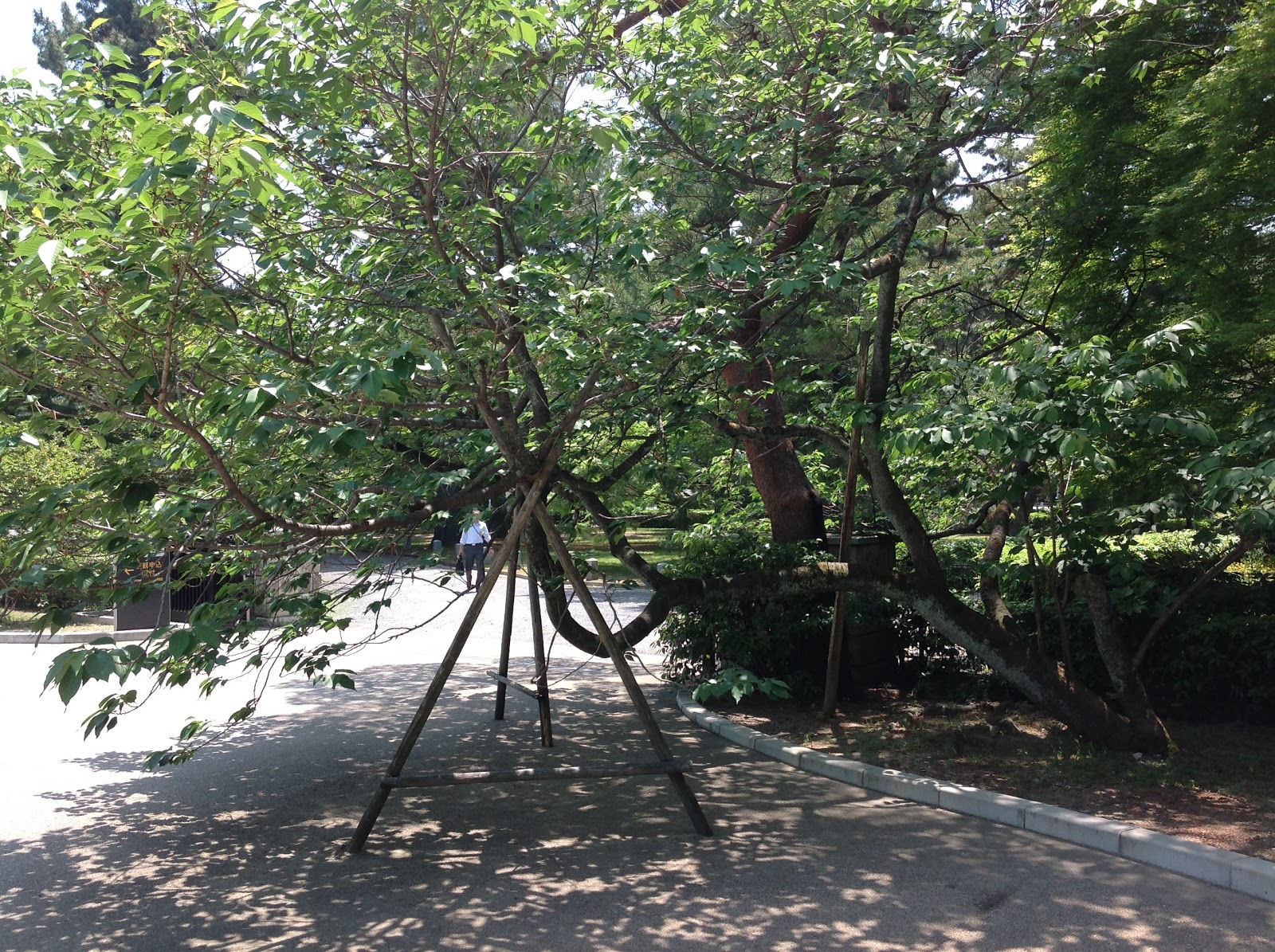
 We'll start with a pretty run-of-the-mill propped up tree.  This is a lovely little pine on the grounds of the Imperial Palace in Kyoto.  There are two perfectly fitted mortices in the cross-piece.  Lovely piece of work.


 A slightly more elaborate propping up.  Also at the Imperial Palace in Kyoto.
 I wish I had some idea about this tree.  It is right at the corner of the castle building, and there was a huge plaque detailing its significance, but of course I could read none of it.  There was a date from the early 19th century, but that was the best I could figure out.  The trunk is about four feet in diameter, and the poles holding up the branches are each a foot thick.  You can get a sense of the scale from the police car there next to the tree.  This was one of the first things I saw in Japan and it won me over immediately.


 A close up of the whole process:  Wrap the branch in bark, then lash it with twine to the support pole.  This way as the tree grows it won't hurt the tree.  In a couple of places we even saw examples of the tree growing to support its own weight and growing off of the support.  Pretty triumphant to see that.
 
 A really nice example of the tree and the prop becoming a threshold into a space.  There is another photo of a similar thing later on, but this is a lovely one.  Many of these trees are bred to grow very slowly, so there is no guarantee that this tree is as callow as it seems, it could be quite old.  Again, this practice is so normative here that there is no comment on it, no way to know anything other than what we see.
 Maybe my second-favorite propped up tree.  So lovely.  This is in Katsura Villa, I think, so of course some of the top arborists in the nation are caring for this one.  I just love the horizontal and the tow verticals set up by this particular tree.
 The base of the supports for this tree land in a gravel garden, as this is in a Zen garden.  I love that the monks rake around the posts, acknowledging them as important objects and incorporating them into the raked pattern.
 A really tall propped up tree here.  Those supports are about thirty feet tall.  Still made the same way, with a perfect mortice at the top and lovingly lashed to the branches.  This  one is so tall that at first you are not aware of them as branch supports, but then you look up and realise that they are not a light post or something, that they are a part of the support system for the tree.


Sometimes support is in tension not compression.  Here is a little tree that is being trained to hang out over a path in a beautiful way.  Callow youth, this one.


I love it when the tree twists around like this.  Looks like the muscles in an arm, don't you think?  Here is an example of a tree that has been so tortuously trained that it could never stand on its own.  But it lives on.  The will to live is tenacious, even in (maybe especially in) trees, and they cling to life with great force of will.
 And here is my all-time, hands-down, favorite propped up tree.  At the entrance to Katsura villa.  Truly lovely, not least because all of the heartwood has been eaten by rot or mold or something, but the sapwood is still keeping the tree alive, twisted though it is.  The supports here are bigger than a foot in diameter.


 Here is another shot of this one.  You can see clear through it.  It is so beautiful, I just sat and stared at it for a long time.  The students were making fun of me after a while, but I did not care, it is just lovely.  I am so thankful that i have seen this old lady, when ever I start feeling like I have reached my limit I will remember her and remind myself to avail myself of support systems and lean on things that I need to lean on.  So much wisdom to learn from trees, and from those who take care of them.
 A nice example from inside Katsura Villa.  The ma created by the supports, the way they are there and not-there as the tree reaches out over the water is pretty amazing.

 From Tneryu-ji Zen temple in Arashiyama.  I love that the one branch has been trained so completely horizontally so that a real threshold has been made.  This is a very typical type, see below.

 From Bizen somewhere on the walk to the sword museum.  Using a tree as a lintel for entry into the house is a very common sight here, and one that I really dig.  What nicer way to delineate space than with trees?
And this poor lady gets the prize for most punk rock tree.  Holy crap.  There is such a thing as too much of a good thing, and this is one propped up tree that really shocked me.  I don't know if some terrible thing happened in its past, or if the gardeners are just over zealous, or what, but this is just crazy.  Nice one to end on, I think.