Today is Mark Twain's birthday. In honor of that I thought I'd post one of my favorite bits of writing from him, found in "Life on the Mississippi," which is a collection of memories and writings all about that great river. Captivating stuff, and a fun read.
This particular passage speaks well to the shift that comes as one moves from novice to skilled artisan. Beauty gets redefined, understanding deepens, worldview shifts. I do not think, as this passage indicates, that the ability to see beauty fades, rather that we understand things to be beautiful in different ways, if we let ourselves. Here, Twain is talking about the process of learning to "read the river" as a riverboat pilot.
"Now when I had mastered the language of this water and had come to know
every trifling feature that bordered the great river as familiarly as I
knew the letters of the alphabet, I had made a valuable acquisition. But I
had lost something, too. I had lost something which could never be
restored to me while I lived. All the grace, the beauty, the poetry had
gone out of the majestic river! I still keep in mind a certain wonderful
sunset which I witnessed when steamboating was new to me. A broad expanse
of the river was turned to blood; in the middle distance the red hue
brightened into gold, through which a solitary log came floating, black
and conspicuous; in one place a long, slanting mark lay sparkling upon the
water; in another the surface was broken by boiling, tumbling rings, that
were as many-tinted as an opal; where the ruddy flush was faintest, was a
smooth spot that was covered with graceful circles and radiating lines,
ever so delicately traced; the shore on our left was densely wooded, and
the somber shadow that fell from this forest was broken in one place by a
long, ruffled trail that shone like silver; and high above the forest wall
a clean-stemmed dead tree waved a single leafy bough that glowed like a
flame in the unobstructed splendor that was flowing from the sun. There
were graceful curves, reflected images, woody heights, soft distances; and
over the whole scene, far and near, the dissolving lights drifted
steadily, enriching it, every passing moment, with new marvels of
coloring.
I stood like one bewitched. I drank it in, in a speechless rapture. The
world was new to me, and I had never seen anything like this at home. But
as I have said, a day came when I began to cease from noting the glories
and the charms which the moon and the sun and the twilight wrought upon
the river’s face; another day came when I ceased altogether to note them.
Then, if that sunset scene had been repeated, I should have looked upon it
without rapture, and should have commented upon it, inwardly, after this
fashion: This sun means that we are going to have wind to-morrow; that
floating log means that the river is rising, small thanks to it; that
slanting mark on the water refers to a bluff reef which is going to kill
somebody’s steamboat one of these nights, if it keeps on stretching out
like that; those tumbling ‘boils’ show a dissolving bar and a changing
channel there; the lines and circles in the slick water over yonder are a
warning that that troublesome place is shoaling up dangerously; that
silver streak in the shadow of the forest is the ‘break’ from a new snag,
and he has located himself in the very best place he could have found to
fish for steamboats; that tall dead tree, with a single living branch, is
not going to last long, and then how is a body ever going to get through
this blind place at night without the friendly old landmark."
Happy Birthday, Mark Twain.
Wednesday, November 30, 2016


Tuesday, December 29, 2015
Teaching Philosophy
I am engaged in something right now that is making me re-read my teaching philosophy. I wrote it last year, but it still feels right. It goes like this:
Teaching Philosophy
I
believe that design and making are active
not passive. We must be present, committed, thoughtful and directly involved in
the world in order to become agents of positive change. To this end, I believe that a solid design
education has three parts: inquiry, making, and aspirational thinking.
Inquiry
When I Socratically
ask a student why they made a particular choice, they must unpack their own
motives and assumptions. This helps them
to be more critical, more aware and more thoughtful as they engage in the
design process. So often we can be unaware of the questions we are really
asking, and this is especially true in young designers. Students in our senior thesis class (a
two-semester required course), determine for themselves the subject of their
individual projects. The only
stipulations are that the thesis must be applicable in Syracuse NY and respond
to a demonstrable need in this locale.
This encourages them to directly engage local communities, to research
existing social and cultural conditions and to think critically about their
response to those conditions. Students
guide their own studio work through discussion with each other and with the
other stakeholders in the project.
One
process that I began implementing three years ago as a research tool is a
volunteering requirement. Each student is required to volunteer for at least 25
hours with a group or organization in Syracuse. This gets them “out of the bubble” of our
University and into the community that surrounds us. For many of our students this is the first
time that they have spent any time with people from a socio-economic background
that differs from their own. By adding
this set of first-person experiences to their academic research, they are able
to create richer and more responsive designs as a part of their thesis
work. One student wrote in an
end-of-semester evaluation “I had no idea about the assumptions I was making
until I spent time with [a client at the Food Bank]. It really changed my design and it also
changed my life.” This is slightly grand
perhaps, but this student’s ultimate design did shift from a relatively shallow
redesign of a community center/soup kitchen into an examination of food systems
in Syracuse and an exploration of food inequities.
This
act of asking, this process of inquiry is not an isolated step in the design
process or the learning process. All the
way through it is imperative that we step back and look critically at the
questions we are asking. I create
opportunities for our students to present their questions to their peers, to me
as a faculty member, and to visiting lecturers as a way to ask, “are the
questions I am asking really the questions I should be asking?” This process of research and evaluation is
carried through the entire design process.
Making
Making is important and relevant, and
irrespective of discipline everything we design must be made by someone
somewhere. I love making of all types, and I am vocal about that. The deeper
each student’s understanding of which making, manufacturing, and building
processes can be drawn upon to realize their design, the more complete their
design approach is. To this end, whether it is in my interior design first-year
studio, my senior thesis studio, or my furniture design classes, making is
built into the syllabus. There is an attention to detail and a respect for
precision that is taught better through the end of the finger than through the
eye and the ear. Though cutting
cardboard may seem trivial in the grand scheme of a design education, there is
a patience and precision and response to material that is learned by doing
that can not be adequately communicated with lectures. In the process of making models in first-year
studio the students learn these skills (patience and precision) as well as
learning that there are limits to and possibilities provided by each
material. These limits and possibilities
are a part of our design lexicon, they enable us to do the work that we do and
to do it beautifully and well.
This
process of practice extends beyond objects and spaces and into
relationships. Every design is about
relationships, and cultivating those relationships is an important part of our
job as a designer and as a teacher. When
the students are doing their volunteer work, they learn by experience this
first-hand: They must listen
respectfully and critically, often having to go to great lengths to tease out
information that they can apply to their design. This making
of relationships is an important skill that is (like cutting cardboard)
best learned by practicing, inside and outside of the classroom.
In
my own work I have spent years learning to be keenly aware of the material I
work with, its origins and its story. It
is important to me to put that story into the finished piece somehow, and to
communicate it to the clients or users.
I believe that this helps the user connect to the finished piece and
gives it a higher personal value, and it is my hope that a higher value leads
to a diminished chance that the object will be cast aside and added to the
waste stream. This awareness of our place in the cycle of creation (as users
and waste creators) colors every design decision I make, from materials to
processes. It drives me to seek out
methods that have the smallest possible negative impact environmentally,
economically, and socially, and the greatest positive impact. It also drives me to communicate this thought
process to my students. This method of
thought spills over into my teaching of course:
There is no shred of knowledge, no bit of experience that cannot be
utilized as an educational tool. The way
that leaves fall off of a tree in autumn, the way two people pass each other in
a hallway, the relationship of bone to muscle to skin in our hands, all of
these are clues to the way the world works.
We can use these as signposts when we engage in our creative process; we
can let them lead us to a more thoughtful, appropriate finished piece.
Aspiration
I
believe that what we do as designers and makers is important; it will change
the world. Even something as simple as
making a mark on a piece of paper changes the world from a world without that mark to a world with that mark. If this is true, if
every design perforce changes the world, I believe we have a responsibility to
do that in a positive way. I believe
that by teaching students the art of inquiry and the craft of making I am able
to help widen what I call the student’s “field of view.” We can easily fall into the trap of thinking
too narrowly, of ignoring the interconnected nature of the world around
us. But every choice we make has effects
that ripple outward, and choosing one material (for example) over another or
one construction method over another can have profound impact on all manner of
other disciplines and industries. To this end, I pursue projects for my
students that respond to that agenda, seeking out socially and environmentally
responsible real world clients like e2e Materials (a local sustainable-product
business), or community gardens and other community centers.
As
field of view broadens, as we become more aware of the interconnected nature of
the things and processes and people in the world around us, we are able to
identify and mitigate the relationships that we are working to improve in a
much more sensitive way. Sometimes this
process is simple: Critiquing a
first-year student’s drawing and noting the lack of crown and base molding in
the drawing can lead to a discussion about the role of molding in an interior
first as way to keep out the cold, then as a status symbol, then (by doing away
with it altogether) as a Minimalist statement about æsthetics. Other times it is more complex: a discussion with a thesis student about
generational poverty leads to insights about the role that government-built
housing (built cheaply and often with little thought about the relationship of
the residence to the end user) can play in underlining and even creating
attitudes about class-identity and self-identity.
These
three components (inquiry, making, and aspiration) are not steps in a process, rather they are twisted around each other like
strands in a rope: they start together
and support each other and run concurrently all the way through the process
arriving together at a student who graduates engaged with the world, looking
critically at that world, and ready to make positive change within that world.
Sunday, June 28, 2015
Death: Before and After.
We only had a couple of days in Paris before we moved on again. Paris (like any major city) is impossible to "do," in the sense that you hear sometimes ("Well, we did London last year and this year we are going to do Paris). There are so many layers; so much history, so much present, so many cultures, so much much much that I think you could live there for years and never “do” it all. I lived in New York City for almost ten years and never made it to the Statue of Liberty, after all.
We happened to be staying a stone's throw from Notre Dame de Paris, and almost accidentally the trip became (mostly) about this structure. Of course it is art-historically significant and I studied it just a bit in college, and of course I was roughly familiar with it as a structure, but truly photos can never prepare one for actually inhabiting a building. What a breathtaking space.
It is a Gothic cathedral (perhaps the Gothic Cathedral) that is vast: Vastly wide, impressively long, and tall in a way that quite successfully makes a human feel tiny in the presence of god, which is what that space was meant to do after all. The builders employed a brand-new architectural conceit that we call a “cluster column,” that is, on the face of the piers that hold up the distant roof are carved delicate, tiny columns, one next to the other in a cluster, almost like a handful of asparagus, or maybe like holding a bunch of drinking straws of various sizes. The effect of this is to draw your eye up up up to the vaulted roof, you almost can’t help but follow the columns up to the heavens and there, peering up at the roof in awe you realize you are gazing heavenward and feeling small. Success in architecture.
This is a building that was begun in the 11th century and took a couple of hundred years to build. Thousands upon thousands of stones to be dressed and put in place, tons of iron to be smelted and cast and forged, beams to be hewn out of trees. It is a representation of millions upon millions of labor-hours of work across generations.
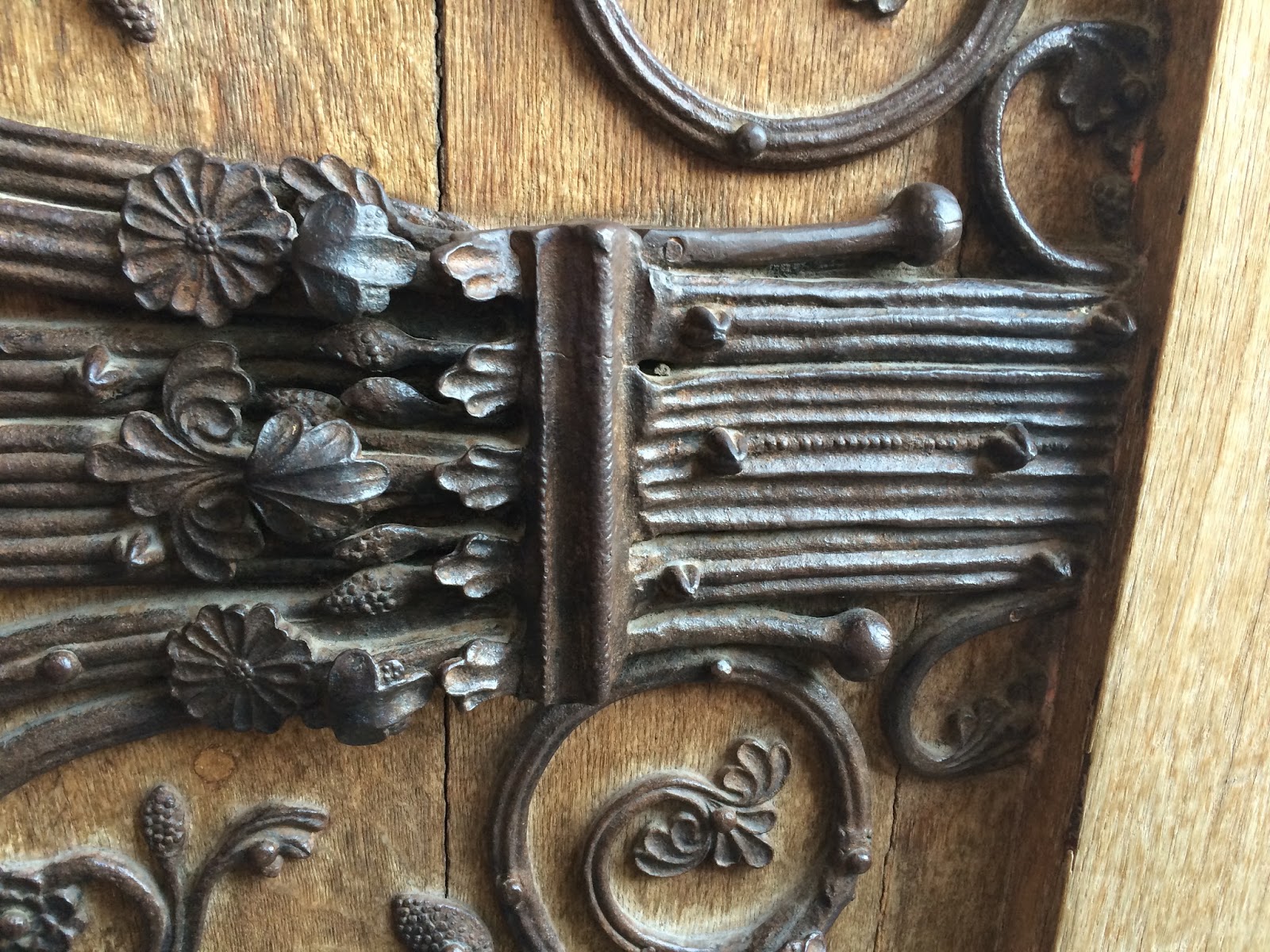
 I was particularly smitten by the
hinges. There are of course three main
doors into the western end of the Cathedral (this is normal for cathedrals,
especially of this style). Each entrance
had a pair of doors and each door had three hinges. “NBD,” as my students say. But these hinges are something else. Large in scale, as everything is large in
scale in this structure, and strong, but visually delicate, almost spidery. They are massive pieces of forged iron, but
have an æsthetic identity that is almost light.
Knowing as I do a little bit about blacksmithing made me appreciate
these hinges even more: the idea of
forging them, even in parts, of getting that intricate detail without deforming
the steel, of achieving that level of symmetry again and again really is a
staggering thought. To look at these
hinges was to look at the work of a true master, a person who is so comfortable
with their hands and their tools and their material that they can make things
that no other, or few other, humans on the planet can make. This person or these people lived a thousand
years ago, and not only does no one now know their names, there is probably no
way to even find out what their names were.
All we have is their work which stands still, a thousand years later, as
testament to lives lived in service to making things with their hands that are
of use and that are beautiful and that are made in a way that with care they
will still do what they are intended to do a thousand years hence. What in my life does the same?
I was particularly smitten by the
hinges. There are of course three main
doors into the western end of the Cathedral (this is normal for cathedrals,
especially of this style). Each entrance
had a pair of doors and each door had three hinges. “NBD,” as my students say. But these hinges are something else. Large in scale, as everything is large in
scale in this structure, and strong, but visually delicate, almost spidery. They are massive pieces of forged iron, but
have an æsthetic identity that is almost light.
Knowing as I do a little bit about blacksmithing made me appreciate
these hinges even more: the idea of
forging them, even in parts, of getting that intricate detail without deforming
the steel, of achieving that level of symmetry again and again really is a
staggering thought. To look at these
hinges was to look at the work of a true master, a person who is so comfortable
with their hands and their tools and their material that they can make things
that no other, or few other, humans on the planet can make. This person or these people lived a thousand
years ago, and not only does no one now know their names, there is probably no
way to even find out what their names were.
All we have is their work which stands still, a thousand years later, as
testament to lives lived in service to making things with their hands that are
of use and that are beautiful and that are made in a way that with care they
will still do what they are intended to do a thousand years hence. What in my life does the same?Which brings me to the Paris Catacombs.
Different from the Roman catacombs in almost every way, the Paris catacombs are a series of tunnels that started as an underground quarry for that white stone that is ubiquitous here. In the late 18th century they started to collapse, and engineers were sent down to shore them up. At the same time, several cemeteries were being emptied, and all of the bones were brought down into the tunnels and stacked down there, since there was nothing else to do with the space. This resulted in a spectacularly creepy environment deep deep underground.
We have to a certain extent become inured to skulls and bones, I think. We see so many toys and Halloween decorations that are skulls and bones that I thought this would be more of the same: slightly creepy but mostly cool, and a fun afternoon. I was wrong on all counts.
As a starter, walking down a continuous stone spiral staircase some 9 or 10 stories underground is enough to creep me out. No elevator, so no quick escape if needed. No landings, either, just a relentless spiral down down down into the clammy darkness. The monotony of this part of the walk is meditative in its way, though the meditation is less than relaxing. At the base of this stair is a hallway, about 6 feet wide and maybe seven and a half feet tall in the center of the gently arched ceiling. Electric wall sconces light the way every thirty feet or so on alternating sides, meaning that the light is patchy, yellow, and barely lights the floor which is sloping, pitted, and, as my wife pointed out, “not something you would ever find in the States.”
The depth of this tunnel is almost palpable, you are keenly aware of the hundreds of feet of stone above you. Every so often there is a tunnel off to the right or left, dark as dark can be and locked off with an iron door like a prison door. I always find that not knowing evokes feeling considerably more than knowing, and the mystery of the dark tunnels with locked doors intensifies the already heightened feeling of extreme creepiness.
Then you get to the bones.
 It is almost like some Disney exhibit, there
are so many. Like the entrance to some
ersatz “pirate cave.” But these are
real. And there are thousands upon
thousands of them. Six or seven foot
retaining walls have been built out of femurs, with courses of skulls either
facing in or out. In some places the
skulls have been arranged in a shape, like a heart or a cross. In others they just continue in a long row,
face after fleshless face staring forever across the hallway at face upon
fleshless face staring back.
It is almost like some Disney exhibit, there
are so many. Like the entrance to some
ersatz “pirate cave.” But these are
real. And there are thousands upon
thousands of them. Six or seven foot
retaining walls have been built out of femurs, with courses of skulls either
facing in or out. In some places the
skulls have been arranged in a shape, like a heart or a cross. In others they just continue in a long row,
face after fleshless face staring forever across the hallway at face upon
fleshless face staring back. I had a real “poor Yorick” moment as I walked
through the cool damp semidark: All of
these bones had been a person, had been a child, had grown up, might have been
a parent or a sibling or a grandmom or a granddad. They probably loved and were loved, they
might have sung songs or played with their children, or enjoyed a sunset. They had birthdays and holidays, they
celebrated and cried. There was a human
life attached to each of these tens of thousands of femurs, each of the tens of
thousands of these skulls. No one will
ever have any way of finding out who these people were, where they lived, or
what their favorite food was. We won’t
know who their first kiss was or what they did as a job, or what was important
to them. These people have been dead for
hundreds of years. All we have are their
bones. Which of course is where the rest
of us are are all headed in time.
I had a real “poor Yorick” moment as I walked
through the cool damp semidark: All of
these bones had been a person, had been a child, had grown up, might have been
a parent or a sibling or a grandmom or a granddad. They probably loved and were loved, they
might have sung songs or played with their children, or enjoyed a sunset. They had birthdays and holidays, they
celebrated and cried. There was a human
life attached to each of these tens of thousands of femurs, each of the tens of
thousands of these skulls. No one will
ever have any way of finding out who these people were, where they lived, or
what their favorite food was. We won’t
know who their first kiss was or what they did as a job, or what was important
to them. These people have been dead for
hundreds of years. All we have are their
bones. Which of course is where the rest
of us are are all headed in time.
Which brought me back to Notre Dame de Paris, and to the
door hinges.
The people who made the door hinges are long lost in time
(“Lost in time like tears in rain,” as Roy Baty says in the Blade Runner
movie), but those hinges remain, and they keep doing the work they were
intended to do. Every morning the doors
swing open and every evening they swing shut, and the hands of the people that
put those doors on the hinges and the hinges on the building, though long
decayed to bones, are accessible to us.
We are so temporary, so fleeting, so small in space and
time. What the Catacombs and Notre Dame
made me think about is the import of making my short time here really mean
something, and of how much I want to make some things that live longer than I
do, even briefly.
Tuesday, May 26, 2015
Takenaka

"There are many things that can be learnt from [master carpenter's] skills and spirit to be applied to contemporary organizations and the making of things."
The last time we were here I raved about The Takenaka Carpentry Tools Museum. It was a central stop last time and was so again this time. This time around they are in a new building, one that has been constructed using ancient techniques but applied to a lovely and thoughtful contemporary building. There are more exhibits, there is a workshop where you can take classes, all the furniture is by local craftspeople, it is crazy.
I won't go back through what I wrote last time, that does not seem to make sense. And I do want this blog to be more than a travelogue, so just posting some photos does not seem to be the right thing either. Why bring a group of architecture and design students to a craft museum at all? None of them want to go into woodworking, so why bother even if it is a stunningly thoughtful and well-designed space?
Well, one answer to that might have been raised by Howard Risatti in his book "Theory of Craft." It's a good book and one that has particular relevance in much of my work. He writes:
When we look at craft objects from different societies...it is clear they all share common functional traits, what we would identify as functional form. It is also clear they have formal differences, these we would identify as their different stylistic forms or styles. Style, or stylistic form in craft objects, always exists along with functional form; but unlike functional form, stylistic form springs from the realm of culture and the intention to meaning, to signification. Moreover, because craft objects are an embodiment of both functional form and stylistic form, they must be understood as having a life as both physical objects and as social objects.
 So a historic hand plane has an existence as an object, a tool, a component in a carpenter's tool kit. But it also has relevance in a conversation about resources and resource usage, and about what a style of work or a style of workmanship communicates about a particular culture. And my hope is that by exposing our students to the style of making in another culture that it will underline for them the stylistic and functional choices and assumptions that they are making in their own work.
Japanese traditional carpentry, like Western carpentry, dictated (in part) the æsthetic that we think of as "Japanese." The mix of wood and clay and stone, the intentional asymmetry, the floor plans dictated by tatami mats, these have their root in how the spaces were made and used.

As we walked around the museum yesterday and I talked about tools and methods, about materials and the way we treat them (they still have the bins full of shavings from different woods so that you can smell the difference between hinoki and oak, for example. IT'S SMELL-O-VISION! WITH WOOD. OMG.) I am hopeful that some of this resonated with the students. I am hopeful that as they move forward in their own design practices some gossamer memory of attention to not just materiality but also the ways that materials are used will have clung tot heir perceptions. Here are some photos and drawings from my favorite museum on the planet.
 |
| The workshop. We did not have a chance to use it, but next time for sure. |
 |
| A huge plane and the shaving that came from it. |
 |
| Looks like a simple joint, right? |
 |
| Here's how that joint goes together. |
 |
| A really amazing display that is sort of a 3D exploded view of a timber framed structure showing all of the joints. |
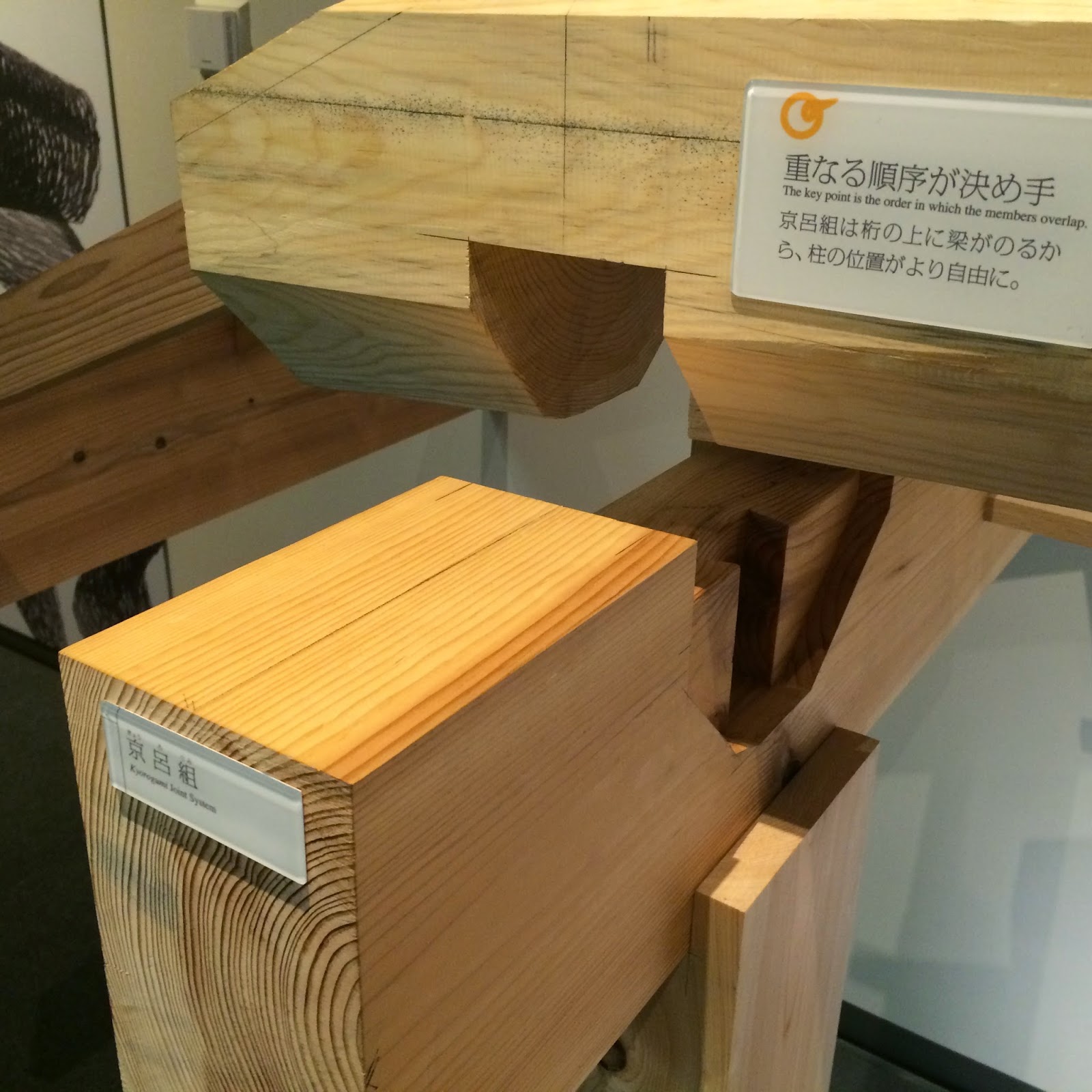 |
| A shouldered sliding dovetail bridle (kyorogumi) joint. |
Saturday, May 23, 2015
Urushi (漆)

The binder for this lovely finish comes from the Japanese Sumac tree, which looks not unlike our own sumac trees back home. This is a very different tree, however: the sap of the Japanese Sumac contains a compound called urushiol, which is the same toxin that is found in poison ivy. The highly skilled craftspeople that work with urushi lacquer go through a period of extreme discomfort during which they are pretty much covered with the painful and highly itchy rash that any sufferer of poison ivy can relate to. I have heard anecdotally that if someone who works with urushi takes a break from it for a week or two they have to build up a tolerance all over again when they come back to it again, that no matter how long one has been working with urushi one still has to get re-acclimatized.
When I was young poison ivy was not of great concern. I had a small case of it once or twice, but mostly I ran through the woods with abandon and very little repercussion. In my early teens I started going to the local YMCA summer camp for a week or two each summer. Camp Hanes taught me a lot of things: it taught me how to be responsible for younger people as a councillor in training (a lesson I put in to practice now in my work life) about rock climbing and backpacking, about how to sneak cigarettes and about power hierarchies and inequities.
One year I was art of a group called the Rangers. It was not as militaristic as it sounds: it was sort of like a work/study program. We went to morning workshops and then in the afternoon we did a few hours of work for the camp. I quite enjoyed it, actually, as even then, when I was thirteen or fourteen or whatever I was I liked to be on the inside, to be part of the workings of a place rather than simply attending the place. It was that same tendency that would lead me to start working backstage on shows, which would take me out of the great outdoors and into large dark rooms and the world of the entertainment industry.
I don't know if Camp Hanes still does the ranger program, I don't know if they would be allowed to. We swung axes and used saws to prune trees, we clipped shrubs, we drove the golf carts around hauling trash, in general doing stuff in the eighties that would probably be looked at very differently in the litigious 21st century.
I can't for the life of me remember who the guy in charge of us was, but I remember what he looked like: skin swarthy form day after day in the North Carolina summer sun, leathery from years of being a Camel smoker. He would smoke cigarettes while we worked, which always made us as campers (who were not allowed to smoke, officially) highly jealous and greatly desirous of a cigarette. I remember him as tall (though in retrospect he may not have been) and I remember he had what we used to refer to as "Dunlop's disease:" his belly done lopped over his belt. He had the thick, slow, round accent of the North Carolina hills, and a parsimony with words that will be familiar to people who have hung out around farmers and country folk at all.
One day our task was to clear the weeds from a small hill side next to the tennis courts. This is probably almost 30 years ago and I remember it vividly. Having been raised baby my mom to recognise plants by their leaves, I immediately spotted that the bulk of the weeds were poison ivy. The boss man handed me a swing blade (a sort of horizontal blade set on a long handle) and told us to get to it.
"But that's poison ivy," I piped up, thinking maybe he had not noticed. "Yep." "And you want us to cut it with these?" "Yep." "Can I at least go up to my cabin and put on jeans?" "Nope. Y'all can shower when yuh finnish." So we got to work. To this day I remember the smell of those huge leaves as the swing blade cut their stems, the baking, sultry heat of the North Carolina summer sun, the sunburn starting to make my scrawny back pink. I did shower, but to no avail, by the next morning the first welts started to form. Then more. Then more yet. All the way up both legs and on both arms the poison ivy rash stood out. I remember how painful it was, how terrifying as it kept spreading. A couple of weeks later I went with my dad to his little home town in Michigan to visit my grandparents and I remember walking up the street with one of those curved chopping knives that I had found in the attic. It reminded me of a battle axe so I was carrying it around. The poison ivy was so itchy I remember stopping on the sidewalk and using the chopping knife to scrape at my legs, bent over and crying in frustration as the welts were torn away and the yellow pus inside them oozed down my legs. Ever after I have been extremely sensitive to poison ivy and have mostly kept well away.
A few days ago, in Kyoto, we took the students to a sushi making experience. We sat at long tables while the sushi chef (who was also the architect of the space and the owner) showed the students how to use the long sushi knife to cut slices of very fresh fish, and how to ball the rice and shape the sushi. It was a fantastic experience and left us all stuffed full of sushi.
After we had eaten, Aki (the sushi chef) told us how the building we were in had been a factory where urushi lacquer was made and applied to rice bowls and spoons. He talked about how he had bought the building and turned it into this beautiful ryokan, or Japanese style hotel, and showed us some lovely and quite old lacquer ware that he had collected, some of which had been made in that factory when it was still a factory. We all listened and learned and generally had a good time. He told us about the big slab tables that we were sitting at and about how he also loves to work wood, and how he had hand planed them and applied the urushi lacquer finish to them himself. And he told us all how the space had only been open for three months but that he was very proud of it.
The next morning when I awoke my wrist was itching. Not a normal "my wrist itches" sort of itch, but a deeper, more painful itch that I have come to know well. Somewhere in that lovely space there must have been some urushi lacquer that was not fully cured. And I found it. And that is how I came to have poison ivy in Japan, and how I now know that the Japanese for "calamine lotion" is "cadamine." And that is is really hard to find anti-itch stuff in a drug store when you can not read or speak the language.
The sushi was fantastic though.
 |
| Ouch. |
Tuesday, May 19, 2015
Engawa (縁側)
As he showed me my room on our first night here, the tall, blonde, German (?) guy who works the desk at our hotel pointed out the lintel above an alcove in my room that leads to the bathroom. "Be careful," he said, "in Japan it is painful to be tall."
Now, I am not a tall guy, being as I am several inches south of six feet. On the other hand, I am in a country in which I routinely find myself talking to or walking past adult humans who do not even come up to my shoulder. So I crack my head on that lintel almost daily and every time I do I think to myself "In Japan it is painful to be tall." We leave tomorrow and I wonder if I will even then be trained to duck as I step up into the little alcove.
 The alcove is worth noting (and I have been since I got here not just because I keep rediscovering the top of the entry with my skull) because it represents a very Japanese space: engawa. Transition is important in traditional Japanese architecture, and passage from one space to another, though fluid, is also often tightly composed. An engawa space is one of the ways that this happens. Typically it refers to a sort of veranda on a traditional Japanese house that is either open to the elements or enclosed with screens. Here's a photo I took of a traditional house in a town called Takeyama last time I was here. You can see the tatami room and then, beyond the screens, the engawa. The user of the space does not walk out from the house into the garden, but has a period of adjustment, and interstitial space that eases the transition. The other thing that this space does is that it allows for very deep eaves on a traditional house, which is good since shoji screens are mostly paper and those eaves protect the walls of the house and the paper screens form the elements.
I don't have a veranda on my third floor room, of course, but this idea of "in between" space is so strong here that in a "Japanese style" room that is not very big to begin with I have not one but two of them. I have been thinking about them as my own little engawa spaces. They both have hardwood floor, and they flank the tatmi room, one inside the door and the other in the headbanging space between my room and the bathroom. In fact, to come into the room, there is a little entry, maybe 3'-0" by 20", then a little step up to an engawa space which is where the closet for my futon is, and then you finally step onto the tatami. The whole of the entry is maybe 36" x 60", so not huge, but there are several transitional spaces, utilising changes of level as well as changes of material and color. The hardwood helps protect the tatmi, of course, but it also allows for an entry into a space, it compresses the user into a small space before opening them up into a larger, brighter space. This has the effect, among other things, of making the space feel bigger than it is, because the user is experiencing it in contrast to the very small transition space. The American architect Frank Lloyd Wright used this kind of transition quite often, and I think he learned it in his travels here.
Being aware of this and experiencing it has been reminding me about the importance of transition, and of honoring the need to allow for transition. So often in my life I do not build in time to process, time to enjoy, time to reflect. So often I go from one thing directly into another. Maybe there is value in emotional engawa. Temporal engawa. Even in this small space "transition" is important enough that space has been set aside for it. Maybe I would do well to take that lesson and apply it elsewhere in my life. At the very least I will tell myself this is why it was so important to put that lintel where it is. Not just to make it painful to be tall.
Though in Japan, it is painful to be tall.
 |
| A sketch of the engawa space leading into the bathroom |

 | ||
| Rough floor plan of my room. |
Being aware of this and experiencing it has been reminding me about the importance of transition, and of honoring the need to allow for transition. So often in my life I do not build in time to process, time to enjoy, time to reflect. So often I go from one thing directly into another. Maybe there is value in emotional engawa. Temporal engawa. Even in this small space "transition" is important enough that space has been set aside for it. Maybe I would do well to take that lesson and apply it elsewhere in my life. At the very least I will tell myself this is why it was so important to put that lintel where it is. Not just to make it painful to be tall.
Though in Japan, it is painful to be tall.
Thursday, May 14, 2015
Hohai (Pray-Respectfully)
On the ridge in the eastern mountains above Kyoto there is a series
of temples and shrines that are linked by a narrow street called Tetsugaku-no-michi, the
Philospher's Path. It is mostly a gravel path with square flagstones
set in it that meanders along the side of a canal that runs the ridge
for quite a while. For a good portion of it there are gnarled and
twisted cherry trees on one side and the canal on the other, and
occasional views across the valley of Kyoto stuffed in between the
mountains. It is a beautiful walk.
The canal is lined with stone, and though the water at the bottom is only maybe a foot deep, the stone-lined ditch is about ten feet deep, and maybe fifteen feet across at the top. The clear water running along the bottom is home to some gigantic carp who lazily face upstream with their mouth open, eating away and generally living the life of Riley, it looks like.
We started on the path at Ginkaku-ji, the "Silver Pavillion," which is a Zen Temple and garden that was finished in 1482. The dates here are arresting for an American, of course. There is a completely different time frame for a lot of the structures in Kyoto than the one we are used to, and it is helpful to me to be jogged in this way. The things that I have been learning and thinking and wanting have been learned and thought and wanted for centuries (millennia, actually) of human experience. This does not make them less real or less important (more of both, actually), but it does help to contextualise my own life to look at it against the backdrop of all of the lives that have come before me I think.
The temple garden is just incredibly stunning. There is a meandering path that takes you around the gravel bed that has been carefully raked, across some small bridges, past a little waterfall. The trees are quite old, some of them, and twisted in ways that are precarious. Many of them are propped up with these gorgeous posts to protect them and keep them standing.
After you meander through the garden there is a path that leads up stone steps and across the ridge and back down, giving the walker views of the temple from above swimming in a sea of leaves. Beyond the temp,d buildings is Kyoto, jumbled and stacked in between the eastern mountains and the western ones, looking for the all teh world as if thousands of toy houses were laid out on a quilt between your legs and then you raised your legs, making them all fall into the valley.
As
the walker comes back down into the garden past a forest of
ruler-straight conifers of some kind (cypress? Juniper?) one of my
favorite trees in all of Japan comes in to view. Twisted like the
muscles of my forearm and propped up and an unbelievable angle, it
really is so lovely and so obviously ancient that I had to spend a few
minutes drawing it.
The garden is so full of tourists like us following the path that it is hard to get a sense of what it must have been like during the Shogunate in which it was built. A place of peace and contemplation and refuge, the quiet must have been almost alarming.

The canal is lined with stone, and though the water at the bottom is only maybe a foot deep, the stone-lined ditch is about ten feet deep, and maybe fifteen feet across at the top. The clear water running along the bottom is home to some gigantic carp who lazily face upstream with their mouth open, eating away and generally living the life of Riley, it looks like.
We started on the path at Ginkaku-ji, the "Silver Pavillion," which is a Zen Temple and garden that was finished in 1482. The dates here are arresting for an American, of course. There is a completely different time frame for a lot of the structures in Kyoto than the one we are used to, and it is helpful to me to be jogged in this way. The things that I have been learning and thinking and wanting have been learned and thought and wanted for centuries (millennia, actually) of human experience. This does not make them less real or less important (more of both, actually), but it does help to contextualise my own life to look at it against the backdrop of all of the lives that have come before me I think.
 |
| On the right is my drawing of a small waterfall in the garden. |
The temple garden is just incredibly stunning. There is a meandering path that takes you around the gravel bed that has been carefully raked, across some small bridges, past a little waterfall. The trees are quite old, some of them, and twisted in ways that are precarious. Many of them are propped up with these gorgeous posts to protect them and keep them standing.
After you meander through the garden there is a path that leads up stone steps and across the ridge and back down, giving the walker views of the temple from above swimming in a sea of leaves. Beyond the temp,d buildings is Kyoto, jumbled and stacked in between the eastern mountains and the western ones, looking for the all teh world as if thousands of toy houses were laid out on a quilt between your legs and then you raised your legs, making them all fall into the valley.
 |
| One of my top 15 trees in Japan and the calligraphy for Ginkaku |
The garden is so full of tourists like us following the path that it is hard to get a sense of what it must have been like during the Shogunate in which it was built. A place of peace and contemplation and refuge, the quiet must have been almost alarming.

 |
| Gardeners at work pruning a tree. |
Subscribe to:
Posts (Atom)